


MariaDB Foundation Newsletter – October 2026
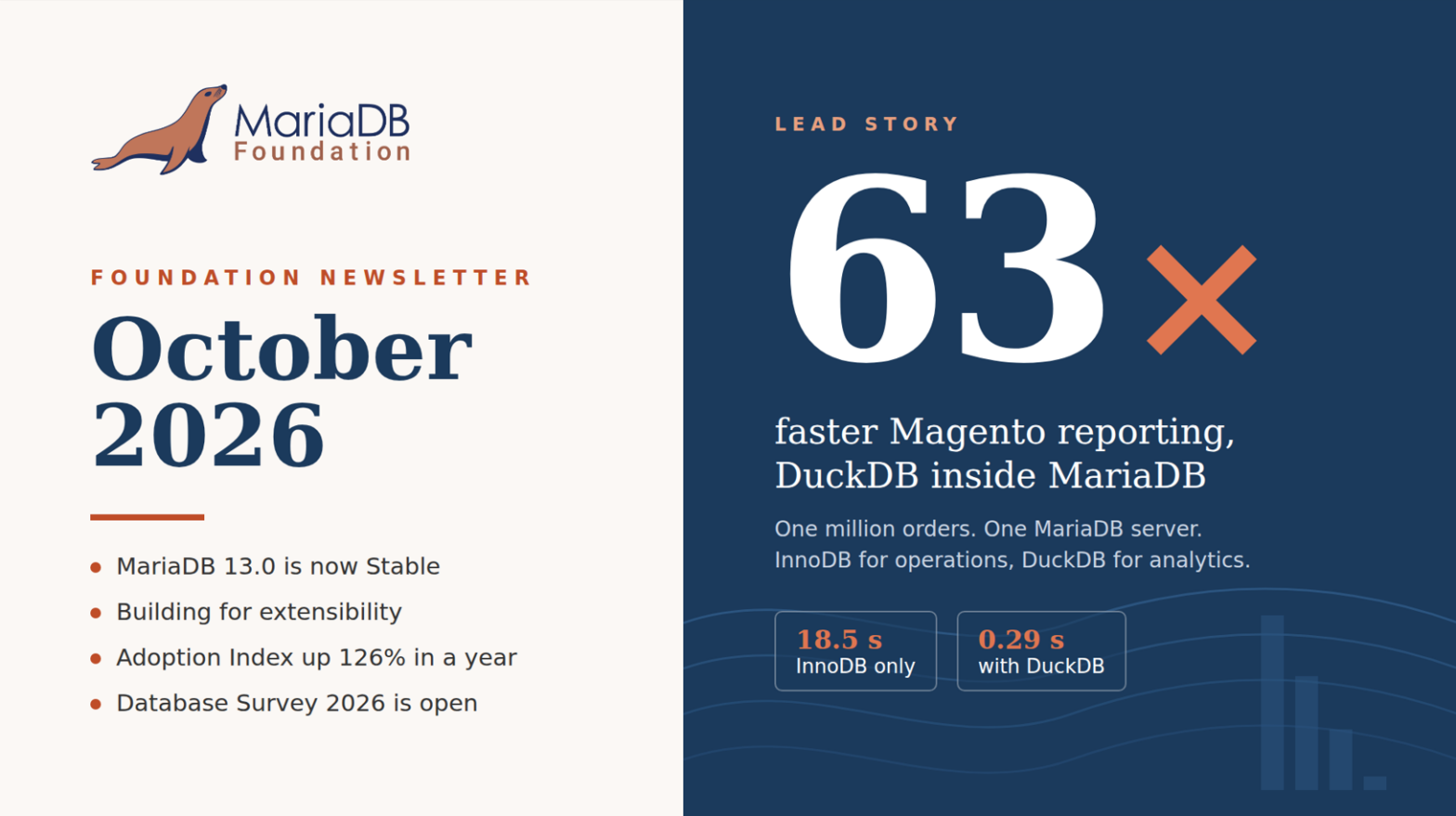
September showed what an extensible MariaDB looks like in practice. A Magento report ran 63 times faster once its tables moved to the DuckDB storage engine, which now ships with MariaDB 13.0, Stable since 17 September. TideSQL became far easier to install, the community voted on writing plugins beyond C++, and the Adoption Index is up 126% in a year. AWS renewed as Diamond sponsor for a fourth year, and Kamatera and Elestio joined as Silver Sponsors. Here’s what happened.
A million Magento orders, 63 times faster: DuckDB inside MariaDB
Magento keeps orders, order items and invoices in InnoDB, which is right for the transactional workload. Analytical reports are a different job. Roman Nozdrin wanted to know whether DuckDB could speed up a real Magento report without replacing the operational database, so he generated one million orders and two million order items and ran the full Magento Orders Report three ways.
On InnoDB alone the report took 18.5 seconds. Moving only the orders table to DuckDB brought it to 8.3 seconds. Moving both orders and order items brought it to 0.29 seconds, 63 times faster. The analytical copies were made with plain SQL (CREATE TABLE … LIKE, INSERT … SELECT, then ALTER TABLE … ENGINE=DUCKDB), and the operational tables stayed on InnoDB.
Roman is careful about what this does and does not show: one report shape, generated data, no concurrency testing. “Every Magento report is now 63 times faster” is not the conclusion. The conclusion is an architecture: InnoDB for the operational layer, DuckDB for an analytical snapshot, both behind the same MariaDB server and the same SQL.
This is MariaDB’s pluggable storage engine architecture doing what it was built for. With Adobe Commerce now defaulting to MariaDB, Magento shops can get fast reporting without adding a second database to their stack. The DuckDB engine ships as a package with MariaDB 13.0.2; it is in gamma, so this is the time to test it, not yet to put it in production.
Trying DuckDB for Magento Analytics: An Experiment with One Million Orders (16 Sep) →
Database Survey 2026
Tell us how you really use MariaDB
What are you building, what works, and what frustrates you? The second annual survey is anonymous, takes eight minutes or less, and has questions tailored to five roles. You don’t need to run MariaDB to take part: we want to hear from MariaDB, MySQL, PostgreSQL and other database users. Last year 275 of you answered, and the results became a public report. This year’s answers will shape where MariaDB goes next.
Sponsor roundup: AWS renews Diamond, Kamatera and Elestio join as Silver Sponsors
Sponsorship gives MariaDB Foundation the resources to support MariaDB Server’s openness, adoption and independence. It sustains our work with contributors, users and the wider ecosystem, helping more people build with MariaDB and take part in its future. Every sponsor, at every level, helps us carry that mission forward.
DiamondAWS renews Diamond sponsorship for a fourth year (14 Sep). AWS became the Foundation’s first Diamond sponsor in 2023. Its continued support gives the Foundation a strong financial base to pursue our long-term mission: growing MariaDB adoption, strengthening its ecosystem and safeguarding the project’s openness and continuity. Announcement
SilverKamatera joins as Silver Sponsor (24 Sep). The global cloud infrastructure provider runs servers across a worldwide network of data centres. “MariaDB belongs wherever developers choose to build and run their applications,” said Anna Widenius. The partnership will focus on making MariaDB easier to deploy and use on Kamatera, with practical guidance for developers building applications on the platform. Announcement
SilverElestio joins as Silver Sponsor (1 Oct). Elestio runs fully managed open source software for its customers, and in the words of CTO Joseph Benguira, “supporting MariaDB Foundation is an investment in the software those customers rely on every day.” Announcement
Thank you to all three: your support keeps MariaDB Server independent and community-led.
MariaDB Adoption Index: up 126% in a year
The monthly index, which combines 24 metrics across downloads, contributors, community and social, is up 126% year over year. mariadb.org downloads grew fivefold (to 526,572 in August), Docker official image pulls reached 25.3 million a month, and 314,637 GitHub projects now mention MariaDB in their README. Unique external contributors rose from 64 to 115, and returning contributors from 5 to 16. Strip out downloads and the index is still up 53%.
The more interesting finding is how people get MariaDB. Debian popcon and Homebrew installs are down about a fifth while containers climb, and new MariaDB questions on Stack Exchange fell from 84 a month to 7. The questions haven’t stopped; they’ve moved to AI assistants, where nobody can count them yet.
Building for extensibility
MariaDB’s strength has always been that it can be extended: storage engines, plugins and tools that plug into one server. Three stories from September push that further.
TideSQL 5: a storage engine you can install like a package
The TidesDB-powered storage engine reaches 5.0.0, based on TidesDB 10, and it can now be built and packaged with MariaDB Foundry as standard RPM, DEB or tar.gz packages, outside the MariaDB source tree. Install MariaDB, then add the engine.
As Frédéric Descamps puts it, “a storage engine becomes much easier to test when installing it doesn’t mean rebuilding the complete database server.” That is how MariaDB gets multiple first-class engines side by side: InnoDB for transactions, TideSQL for write-heavy ingestion, DuckDB for analytics, all behind one SQL interface.
TideSQL 5 and MariaDB: the Tides Are Moving Fast (23 Sep) →
Plugins beyond C++: the community has voted
2,090 people answered which language they would use to write MariaDB plugins (MDEV-40189). Python leads with 21%, Rust follows at 19%, and only about 4% plan to stick with C++.
Today, extending MariaDB means writing C or C++. Supporting other languages would open plugin development to far more developers. MDEV-40189 is open and unassigned, and a small proof of concept in any language would already help.
MariaDB Plugins Beyond C++: What the Community Told Us (4 Sep) →
Test Automation Framework 4.0
The Foundation’s performance testing framework gets its biggest rework since its creation, with new tagging and reporting, PostgreSQL support in beta alongside MariaDB and MySQL, and contributed TidesDB configurations. Several changes came from Monty’s own requests.
Performance claims are only as good as the testing behind them. TAF is open because, as the release post puts it, “performance change detection should benefit the entire database ecosystem, not just one project”, and new engines like TideSQL can be measured with the same tools as InnoDB.
MariaDB Foundation’s TAF 4.0 Release (28 Sep) →
A chocolate wrapper and concurrent InnoDB page splits
A conversation with Monty at Meet Magento Czech, sketched on the back of a dark chocolate wrapper, became work on letting independent parts of the InnoDB B+Tree progress concurrently during inserts, moving structural work outside the globally serialized path. Roman Nozdrin tells the story.
From a Chocolate Wrapper to Concurrent InnoDB Page Splits (5 Sep) →
Also worth a look
Daniel Black on Rethinking PAM (7 Sep) for a Linux environment that has changed in 15 years. Sergei Petrunia on JSONPath lax mode (16 Sep, MDEV-40746) and, with Yuchen Pei, on how MySQL implements JSON ARRAY indexing (2 Sep, MDEV-40822). Frédéric Descamps on migrating MySQL users with pt-show-grants (7 Sep), and on Connector/C compatibility and CONC-821 (3 Sep).
MariaDB 13.0 is now Stable
MariaDB Server 13.0.2 completed its journey from Preview (March) through Release Candidate to Stable on 17 September. Between RC and Stable alone, the branch took 604 commits, touched 1,701 files, added 23,748 test lines and closed 335 MDEVs.
The series brings deeper Oracle PL/SQL compatibility with REF CURSORs and RECORD types, UPDATE … RETURNING, the QB_NAME() optimizer hint, richer optimizer and metadata visibility, InnoDB log archiving, Performance Schema digest changes, replication improvements and security fixes reported through MariaDB’s HackerOne program, plus the DuckDB engine package. 13.0 is a rolling release, not an LTS; if a long maintenance window matters most, 11.8 LTS remains the natural choice.
MariaDB 13.0 Is Now Stable (17 Sep) →
Connectors and cloud
Connector/C 3.4.11 and 3.3.21 shipped on 29 September, and Connector/R2DBC 1.4.2 (3 Sep), 1.3.2 and 1.2.4 (23 Sep). On AWS, Amazon RDS for MariaDB now offers the Q3 community releases 10.11.19, 11.4.13, 11.8.9 and 12.3.3, including post-quantum TLS key exchange.
Amazon RDS for MariaDB minor versions (8 Sep) →
From MariaDB plc
Galera stays in MariaDB Community Server. (17 Sep) As MySQL Galera Cluster reaches end of life on 30 September, MariaDB plc confirmed that MariaDB Galera Cluster remains part of MariaDB Server, open source, in both community and enterprise editions, with node-by-node and replication-based migration guides for MySQL Galera users. Read
Enterprise Server 12.3 beta and maintenance releases. (7 and 15 Sep) A first beta with conflict-aware replication, a Raft-based cluster and passwordless TLS authentication, plus security maintenance releases 11.8.9-6, 11.4.13-10 and 10.6.28-24. Beta · Maintenance releases
New on video: JOIN TABLES and The Fork
The Foundation launched two video series in September. JOIN TABLES opens with Sveta Smirnova of Percona on two decades of database support, how AI has changed the job, and why she recommends motorbikes for the engineering mind. The Fork asks many people one question at conferences; episode 1, filmed at Percona Live Amsterdam, asks about the future of databases. Both are on the Foundation’s YouTube channel.
Verify, Measure, and Get Your Hands Dirty: Sveta Smirnova (18 Sep) →
The database world grew up
The first European Percona Live since before the pandemic brought the whole MySQL family into one building, and Kaj Arnö wrote up what he saw. Percona’s own recap of Marco Tusa’s keynote covers an open FIPS build, vectors and the Binlog Server.
Notes from Percona Live Amsterdam (17 Sep) →
On the road
After Amsterdam, the Foundation carried the sea lion to the Nextcloud Community Conference in Berlin (19–20 Sep), Nerdearla in Buenos Aires (22–26 Sep) and MySQL BR Conf in São Paulo (26 Sep), where Monty Widenius and Roman Nozdrin talked about extensibility, the roadmap and the DuckDB storage engine.
Oracle MySQL
MySQLMySQL 26.10.0 Early Access. (25 Sep) Out for preview and feedback, following the first calendar-versioned Innovation release, 26.7. Announcement
MySQLA rebuilt MySQL Workbench and monthly security patches. (10 Sep) Workbench 26.7 is a ground-up rebuild on the MySQL Shell foundation, replacing Workbench 8, and Oracle is adding monthly Critical Security Patch Updates between its quarterly CPUs. Workbench 26 · CSPUs
Percona
PerconaVector distance lands in Percona Server for MySQL. (21 Sep) Percona Server 9.7.2-2 adds a DISTANCE() function for vector similarity and open source OpenID Connect authentication. Approximate nearest-neighbour indexing is still to come; MariaDB Vector has shipped with an HNSW-based index since 11.7. The write-up
PerconaPerformance gains and LLMs as DBAs. (15 and 17 Sep) Percona Server 8.4.11-11 brings notable performance improvements, and Vadim Tkachenko built a harness to test how well LLMs handle real DBA tasks. Performance · LLMs for DBAs
VillageSQL
VillageSQLA burst of extensions. (8–23 Sep) VillageSQL Server 0.0.6 arrived with DuckDB queries from inside MySQL, an early HNSW vector index, an MCP server for AI agents, OAuth2/JWT logins and in-database cryptography. Village News roundup
Elsewhere
OurSQLOurSQL Foundation relaunches. (2 Sep) A neutral home for the wider MySQL ecosystem. Introducing the OurSQL Foundation
ProxySQLProxySQL and dbdeployer. (5 and 29 Sep) ProxySQL shipped 3.0.11, 3.1.11 and 4.0.11 and previewed ProxySQL.Cloud; dbdeployer 2.4.2 makes MariaDB sandboxes faster to spin up. Releases · dbdeployer
dbtrailDuckDB keeps spreading. (29 Sep) dbtrail open-sourced an analytical replica that follows the binlog into Parquet files you query with DuckDB. Introducing the Analytical Replica
Ecosystem Hub
Explore the MariaDB ecosystem, and help it grow
The MariaDB Ecosystem Hub brings together tools, applications, hosting services and solution stacks that work with MariaDB Server. Discover options for your next project, explore integrations, and find providers supporting MariaDB. If you build or maintain something that belongs in the Hub, send us a submission to help more people discover it.
We’re so frustrated that the world doesn’t understand that MariaDB has vectors.Kaj Arnö in The Register, 24 Sep
The Register spoke to Foundation executive chairman Kaj Arnö at Percona Live about why LLMs are the new search engines: MariaDB has vector search built in, but coding assistants rarely suggest it unless asked, partly because their training data predates the feature. His answer is to ship it, document it, and get people using it. For MariaDB, LLMs are the new search engines to win over
| Date | Event | Location |
|---|---|---|
| 7–8 Oct 2026 | Open Source India | Bengaluru, India |
| 7–9 Oct 2026 | Open Source Summit Europe | Prague, Czechia |
| 24 Oct 2026 | BuildDevCon – Vector Databases | Online |
Full listing at mariadb.org/events
