


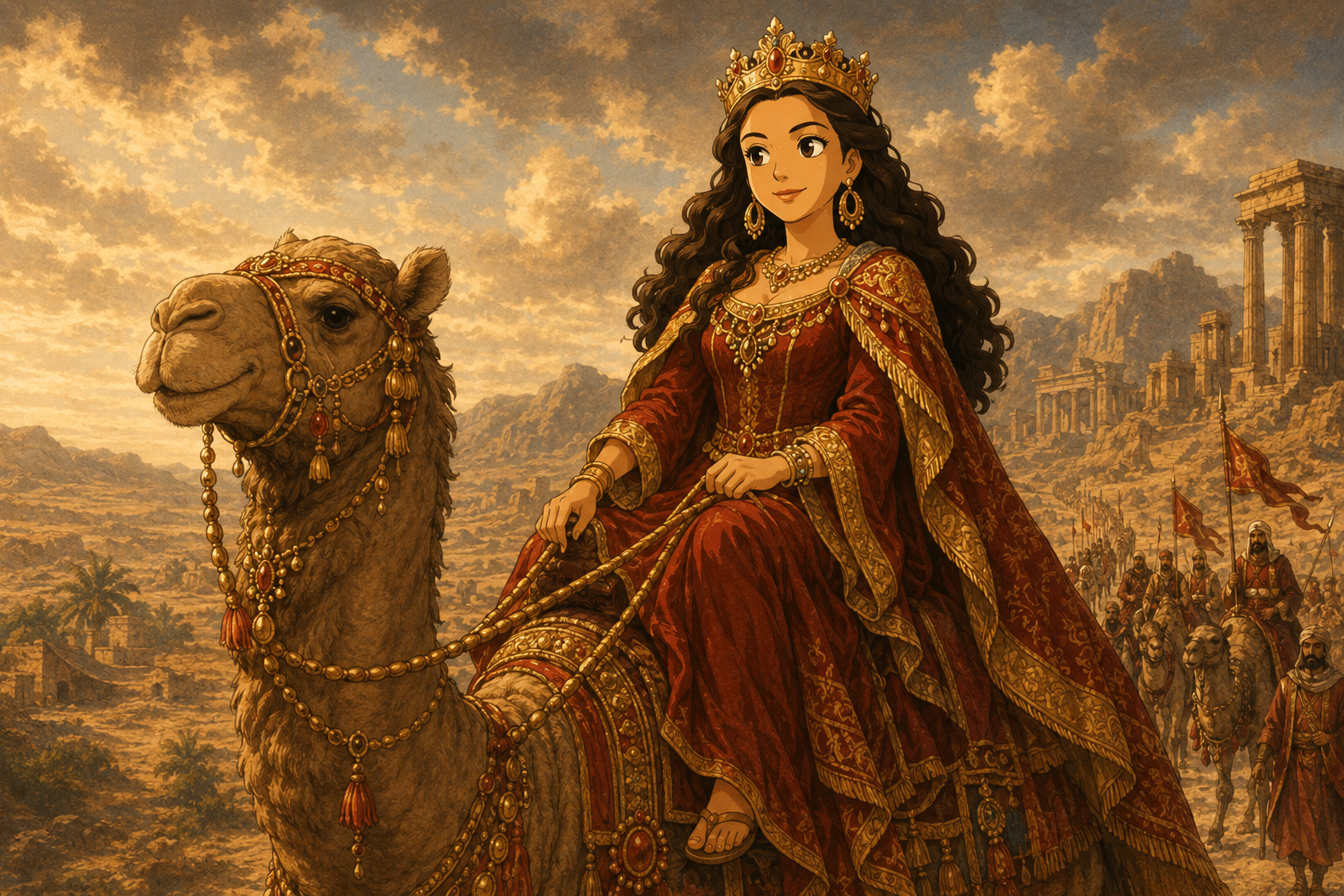
The Queen of Sheba did not travel lightly.
She arrived in Jerusalem with difficult questions, a large caravan, camels carrying spices, and an impressive quantity of gold. She had heard stories about Solomon’s wisdom and the prosperity of his kingdom, and she came to examine it for herself. The main methodological difference between us is that she did not send a Calendly link first.
After seeing the court, the people, the organisation and everything that had been built, she admitted that the reports had failed to capture its true scale:
“Not even half was told me.”
The story does not tell whether she arrived on a high horse. It does mention camels.
I, however, have spent much of the past year and a half falling from mine.
The kingdom I thought I knew
I have been part of the MySQL/MariaDB world since 2002. That is long enough to let yourself believe that you know the territory and everyone who populates it.
I knew the major companies. I knew the familiar projects, the maintainers, the service providers, the hosting companies, the database tools and the people who tend to appear whenever two or three database geeks gather around a conference coffee machine.
Of course, I understood that the ecosystem was larger than my personal address book.
I simply did not understand how much larger.
When we launched the MariaDB Server Ecosystem hub in March, I initially thought of it as a way to map and present the ecosystem we already had. We would gather the tools, services, applications, infrastructure providers and projects that work with MariaDB, organise them properly and make them easier for users to discover.
A useful catalogue. A clearer map. A more elegant royal guest list.
Then the gates opened.
New projects appeared. Companies I had never spoken to turned out to have substantial MariaDB businesses. Technologies that had never described themselves as part of the MariaDB ecosystem were already being used alongside MariaDB every day. Hosting led to migration. Migration led to tooling. Tooling led to observability. Hardware conversations led to benchmarking, and sovereign cloud discussions led to open-source applications, security and public-sector deployments.
The map kept growing new coastlines while we were drawing it.
Ecohub keeps attracting visitors and submissions. More importantly, it has changed the conversations we are having. Companies keep recognising that they already have a role in the MariaDB ecosystem.
It has also taught us how people search. They go looking for the whole palace: a webshop, a booking system, a hosting platform, an analytics pipeline. The foundation stones are expected to be in there somewhere, doing their quiet work. That is why we created Solution Stacks: complete, working architectures with “MariaDB inside”, assembled from Ecohub entries. Several are already live, and we are building more together with our sponsors.
What began as a catalogue started becoming a growth engine.
The hidden gem in the palace basement
The second discovery was more surprising.
Many of the organisations I speak with are deeply familiar with open source. They build on it, distribute it, provide services around it and depend on it for important parts of their business.
Yet even within open-source-aware companies, one of its simplest economic propositions is often overlooked:
Bring your patch upstream.
Companies sometimes maintain internal MariaDB patches for years. The patch solves a real problem, perhaps an optimisation for their infrastructure, a compatibility improvement, an operational feature or support for a particular platform.
An internal patch is a surprisingly demanding palace pet. It may begin as a small and helpful creature. Several releases later, it occupies the entire basement, requires a specialist feeding schedule, and obeys only an engineer who left the company in 2019.
Upstream contribution changes that equation. Bring the work into the open, let the community and maintainers review it with you, and once accepted it becomes part of the shared code base, tested with every future release and maintained as MariaDB Server evolves. The company sheds a long-term burden, other users gain the improvement, and the contributor gains influence through real participation.
This may sound like Open Source 101. Apparently, Open Source 101 still needs a travelling lecturer, a diplomatic delegation and possibly several camels.
It has therefore become an important part of our partner discussions. We ask companies what they have built, which patches they carry, where their users experience friction and which improvements could become part of the shared upstream project.
Sometimes ecosystem development begins with a grand new initiative.
Sometimes it begins by discovering what hidden gems have been sitting in someone’s basement for five years.
MariaDB’s secret doors
The third lesson concerns MariaDB Server itself.
It is extensible by design. Its storage-engine architecture is the most obvious example, although the story reaches much further: user-defined functions and plugins like, authentication, auditing, encryption, data types, parsers and specialised server capabilities.
MariaDB can become a platform on which others build new database capabilities.
Yet this is not how many developers, technology companies or even parts of the database industry perceive it. People know MariaDB as an open-source relational database, and many know it as the natural path forward for MySQL users. Far fewer recognise the range of things that can be built inside it, around it and through it.
A technical capability that nobody knows about is a locked door without a sign.
So we are changing the signs: clearer messaging, better documentation, visible contribution paths, and a plugin catalogue on Ecohub where builders soon can publish, explain and maintain their work.
Two unicorns have already wandered through these newly illuminated doors.
The first is the DuckDB storage engine, which brings DuckDB’s columnar analytical capabilities into the MariaDB SQL environment. Applications can continue working with MariaDB while analytical workloads gain access to a specialised engine.
The second is TideSQL, a pluggable MariaDB LSM storage engine built on TidesDB, bringing another distinct set of storage capabilities into the ecosystem.
I call them unicorns because they make an abstract architectural promise visible.
“MariaDB is extensible” is a statement.
DuckDB and TideSQL are things you can build, install, test and use.
Once people see two unicorns, they begin looking for the rest of the herd. The correct collective noun for unicorns is apparently a blessing. In our case I will accept either.
Sixty sponsors and several invisible salespeople
For much of the Foundation’s history, sponsorship centred on a small number of major organisations funding continuity. They helped ensure that the Foundation, its infrastructure and independent stewardship remained in place.
That remains fundamental.
And I used to think that this is really all there is to it. But – another lesson for me – I have learned that sponsorship grows more sustainably when companies can see a direct connection between supporting the Foundation and participating in the ecosystem.
A hosting company may help users migrate to MariaDB. A hardware company may optimise and benchmark it. An application may form part of a Solution Stack.
Our role is to discover that connection and make it useful. Sponsorship then becomes part of visible participation: companies support the shared platform while gaining credibility, relationships, technical alignment and a clearer place in the MariaDB story.
The approach appears to be working.
This year we have reached 60 confirmed sponsors across the different sponsorship levels, with more than 100 additional prospective partners in conversation.
I have been informed that this level of activity would normally require a sales department of somewhere between nine and fourteen people.
I have searched the Foundation virtual offices carefully.
The additional salespeople remain extremely well hidden.
It is possible that they all share my calendar, LinkedIn account and nervous system.
Still, the number that matters most is not sixty. Each sponsor represents another relationship between MariaDB and the world around it. Each one brings users, knowledge, infrastructure, technology, feedback or access to a community we could not reach alone.
The unexplored half
The Queen of Sheba’s revelation was not that everything she had believed was wrong. The kingdom was simply larger, more complex and more impressive than the reports she had received.
That is how I now feel about the MariaDB ecosystem.
The past year and a half has taught me that an ecosystem cannot be understood from a list of familiar company names. It lives in integrations, internal patches, small open-source projects, cloud images, hosting platforms, university work, deployment scripts, specialised engines and conversations that have not yet happened.
The half that was not told is still growing.
That may be the most encouraging lesson of all.
So, to everyone building with MariaDB, around MariaDB or somewhere unexpectedly adjacent to MariaDB: come and tell us what we have missed.
Show us your project.
Bring us the patch from your basement.
Introduce us to the tool, platform or service your users already depend on.
Perhaps join the Ecohub. Perhaps contribute upstream. Perhaps become a sponsor and help us sustain and expand the shared kingdom.
After twenty-four years, I am finally becoming comfortable with one important truth:
I do not know everyone in the MariaDB ecosystem.
And I cannot wait to meet the rest.
Do bring the camels.
Anna Widenius The Accidental Queen
