


MariaDB Foundation is pleased to announce the publication of our first MariaDB Server Solution Stack in the MariaDB Server Ecosystem Hub:
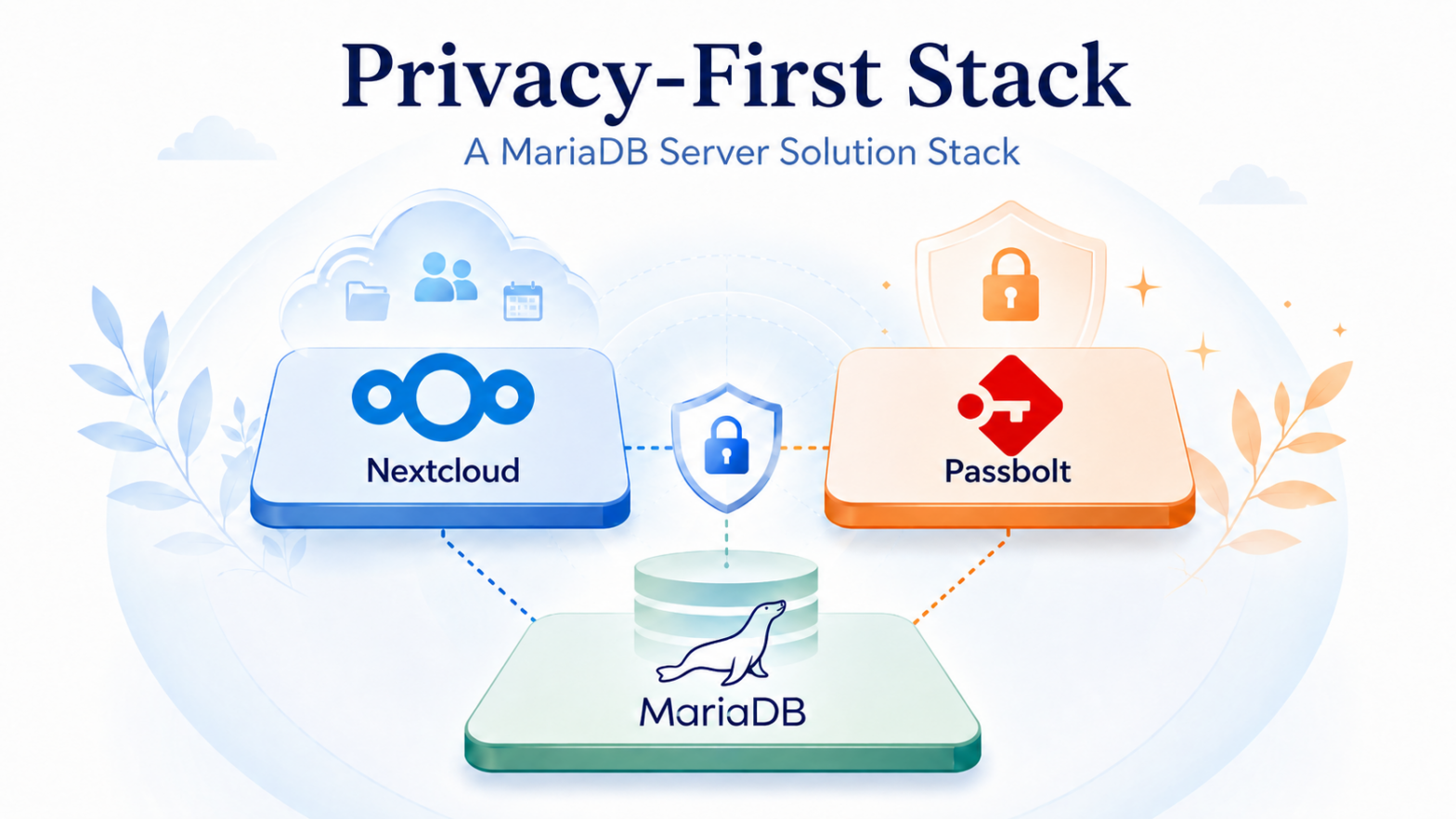
Privacy-First Stack: Nextcloud, Passbolt, and MariaDB Server
This stack brings together three open-source technologies with a shared purpose: helping organizations build collaboration infrastructure around privacy, control, and long-term digital sovereignty.
The stack combines:
- Nextcloud for file sharing, synchronization, and collaboration
- Passbolt for password, credential, and secrets management
- MariaDB Server as the open-source relational database layer at the core
Together, they form a practical architecture for organizations that want to keep collaboration data, credentials, and structured data under their own control.
What is a MariaDB Server Solution Stack?
The MariaDB Server Ecosystem Hub helps users discover tools, platforms, services, and projects that integrate with MariaDB Server.
Solution Stacks go one step further.
A Solution Stack is a practical reference architecture built around a real-world use case. Instead of presenting a single integration, it shows how several technologies can work together to solve an infrastructure problem.
Each stack is designed to help users understand:
- which components belong together
- what role MariaDB Server plays in the architecture
- what problem the stack solves
- how the model can be deployed, tested, or adapted
- which ecosystem partners are involved
For MariaDB Foundation, Solution Stacks are also a way to strengthen collaboration across the open-source ecosystem. They create a shared space where database infrastructure, applications, security tools, hosting providers, and service partners can be presented as part of practical deployment patterns.
The Privacy-First Stack is our first published Solution Stack, and it represents the direction we want to take with the Ecosystem Hub: moving from discovery toward practical architecture, partner collaboration, and real deployment use cases.
Why a privacy-first collaboration stack?
Many organizations rely on convenience-driven SaaS platforms for file sharing, collaboration, credential management, and internal operations. These tools are often easy to adopt, but they can also create overlapping trust boundaries and long-term dependency on external providers.
For teams working with sensitive data, regulated environments, public-sector requirements, or European digital sovereignty concerns, infrastructure design matters.
A privacy-first architecture helps organizations:
- control where their data is stored
- separate collaboration data from secrets and credentials
- define their own backup and retention policies
- manage access at both application and database level
- reduce dependency on proprietary cloud databases
- build around open-source components that can be inspected, deployed, and governed independently
The Privacy-First Stack addresses this by combining collaboration, secrets management, and data persistence into a layered open-source architecture.
MariaDB Server at the core
In this stack, MariaDB Server acts as the core persistence layer.
Nextcloud and Passbolt each serve a different purpose, but both depend on reliable structured data storage. MariaDB Server provides that foundation.
The recommended design uses separate databases and credentials for each application, for example:
- nextcloud
- passbolt
This separation supports stronger isolation between application layers while keeping database governance centralized. Organizations can define their own backup policies, retention rules, replication model, disaster recovery approach, and access controls.
For deployments that require higher resilience, the architecture can also be extended with MariaDB Galera Cluster for high availability.
This is where MariaDB becomes more than a technical component. It becomes the anchor of autonomy in the stack: the layer that helps ensure data remains under the organization’s own jurisdiction and control.
Nextcloud for collaboration
Nextcloud provides the collaboration layer of the stack.
It gives organizations a self-hosted platform for file storage, sharing, synchronization, document collaboration, calendars, and communication. For teams that want an alternative to proprietary public cloud collaboration platforms, Nextcloud offers a way to keep collaboration data closer to the organization’s own infrastructure and governance model.
Passbolt for secrets and credentials
Passbolt provides the security and access layer of the stack.
It is an open-source password and credential management platform designed for teams. Passbolt helps organizations manage and share credentials securely, support onboarding and offboarding, maintain accountability, and avoid spreading sensitive access details through informal channels.
In this architecture, Passbolt is separated from the collaboration layer and uses its own MariaDB database and credentials. This separation is central to the stack’s privacy-first design.
From concept to deployment
The published stack includes example deployment guidance using Docker, showing how MariaDB Server, Nextcloud, and Passbolt can be configured together.
The architecture can be adapted depending on the organization’s needs. A simple deployment can run all components in a compact environment for testing or smaller use cases. A more robust deployment can separate components across systems. For production environments with stronger availability requirements, the database layer can be designed around MariaDB Galera Cluster.
A Solution Stack is not meant to prescribe only one deployment model. It provides a practical starting point that users, partners, and service providers can adapt to their own operational requirements.
Explore the stack
You can view the full Privacy-First Stack here:
Privacy-First Stack: Nextcloud, Passbolt, and MariaDB Server
This is our first MariaDB Server Solution Stack, and we see it as the beginning of a broader conversation.
What kinds of problems would you like to see solved with MariaDB Server and ecosystem partners?
If you are a user, developer, open-source project, service provider, hosting company, or technology partner, we would be happy to hear which real-world deployment patterns would be useful to you. With Solution Stacks, our goal is to make MariaDB-based architectures easier to discover, understand, deploy, and improve together.
