


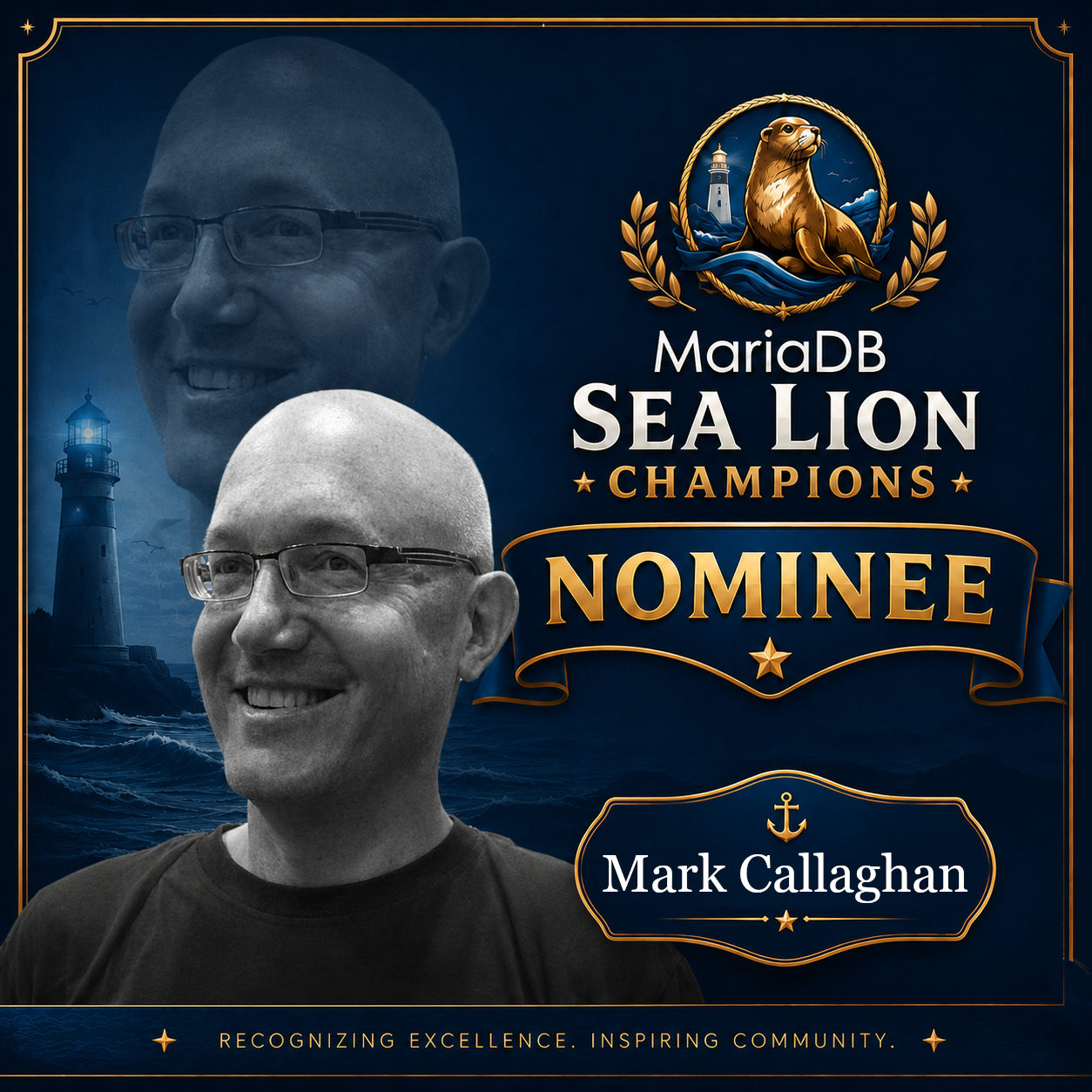
Interview with Mark Callaghan, nominated in the Technical Excellence category.
I had the pleasure of speaking with Mark Callaghan, recently nominated for the MariaDB Sea Lion Champions program in the “Technical Excellence” category. Mark is a respected figure in the database community, known for his in-depth performance analysis and contributions to the open-source dialogue.
The Interview
lefred: Mark, congratulations on your nomination as a MariaDB Sea Lion Champion. How do you feel about this recognition?
Mark Callaghan: I am always grateful for acknowledgment. But I’m a private person, so I’m not always comfortable standing out.
lefred: Your work is remarkable, especially your performance analyses and blog posts on various databases, including MariaDB. What motivates your involvement in these projects, whether paid or personal?
Mark Callaghan: I’m a consultant at this point. I work part-time on a variety of database projects—some are paid, some are unpaid hobby projects. I enjoy working on projects where I can have an impact.
lefred: Having tested MariaDB extensively, what is your general feeling about it? Are the engineers doing a great job, or are there areas where improvements are needed?
Mark Callaghan: There are some areas where MariaDB is excellent, and generally, when I find those, I write blog posts. There are other areas where it needs improvement, and when I find those, I file bug reports. What I like is being able to engage with the developers working on the product. For me, that’s a key part of what you get from open source: a community where you can be in direct contact with the key contributors when it’s a good use of their time.
lefred: You’ve also tested very specific MariaDB innovations, such as the new InnoDB-based binlog and vector similarity search. What can you tell us about that?
Mark Callaghan: Regarding vector search, I entered the work knowing very little about the algorithms in general. So it was great to see that it was faster. My goal isn’t to argue that product A is better than product B, but to document the differences and trade-offs. The HNSW algorithm, as modified by MariaDB, is an interesting improvement in CPU efficiency for vector search. I continue to ask them to publish a conference paper on this, as it’s a really big deal that would interest academics and industry. I push MariaDB marketing to focus on this innovation.
As for the binlog storage engine, it’s definitely a big deal. I was expecting a 2x performance improvement, but in many cases, I saw much more than 2x. This is especially important on cloud hardware, where fsync can be very slow. It provides a big performance boost without forcing you to turn off safety concerns.
Sergei Golubchik wrote a blog series explaining how the Vector Search is working in MariaDB Server:
- MariaDB Vector: How it works
- MariaDB Vector: How it works. Part II
- MariaDB Vector: How it works. Part III
- MariaDB Vector: How it works. Part IV
I also recommend to check some of the slides in this presentation that are dedicated to our Vector’s impementation: here.
Interviewer’s note
lefred: I recently discovered MariaDB’s built-in online schema change feature, which minimizes lock times and replication lag. Were you aware of it?
Mark Callaghan: I have not followed that closely. But seems interesting; I might look at it.
lefred: It’s a very interesting innovation because it handles changes internally, which is very efficient. This could be the subject of a future blog post comparing performance with and without this feature.
Mark Callaghan: That’s another thing to put under the MariaDB innovation marketing tag. I continue to nag everyone at MariaDB that I talk to, that hey, you need to market the innovation. Go with the positive marketing you’re doing. A lot of good changes to MariaDB. Tell us about them until we get tired of hearing about it.
lefred: That’s exactly what I’m trying to do now: always talk about the good stuff we have. To conclude, we also discussed MySQL’s history under Oracle’s ownership. Before the interview, we discussed MySQL’s situation. What do you think?
Mark Callaghan: I prefer to focus on the fact that Oracle gave us 15 years of decent ownership. Now the situation has evolved, and it has become very hard to stay aligned with the company’s direction.
Thank you, Mark, for sharing your thoughts. Your outstanding work on performance and benchmarking brings great value to the MariaDB community, and your dedication is truly appreciated.
