
Building a MariaDB Performance History Library with Hetzner Sponsorship and TAF

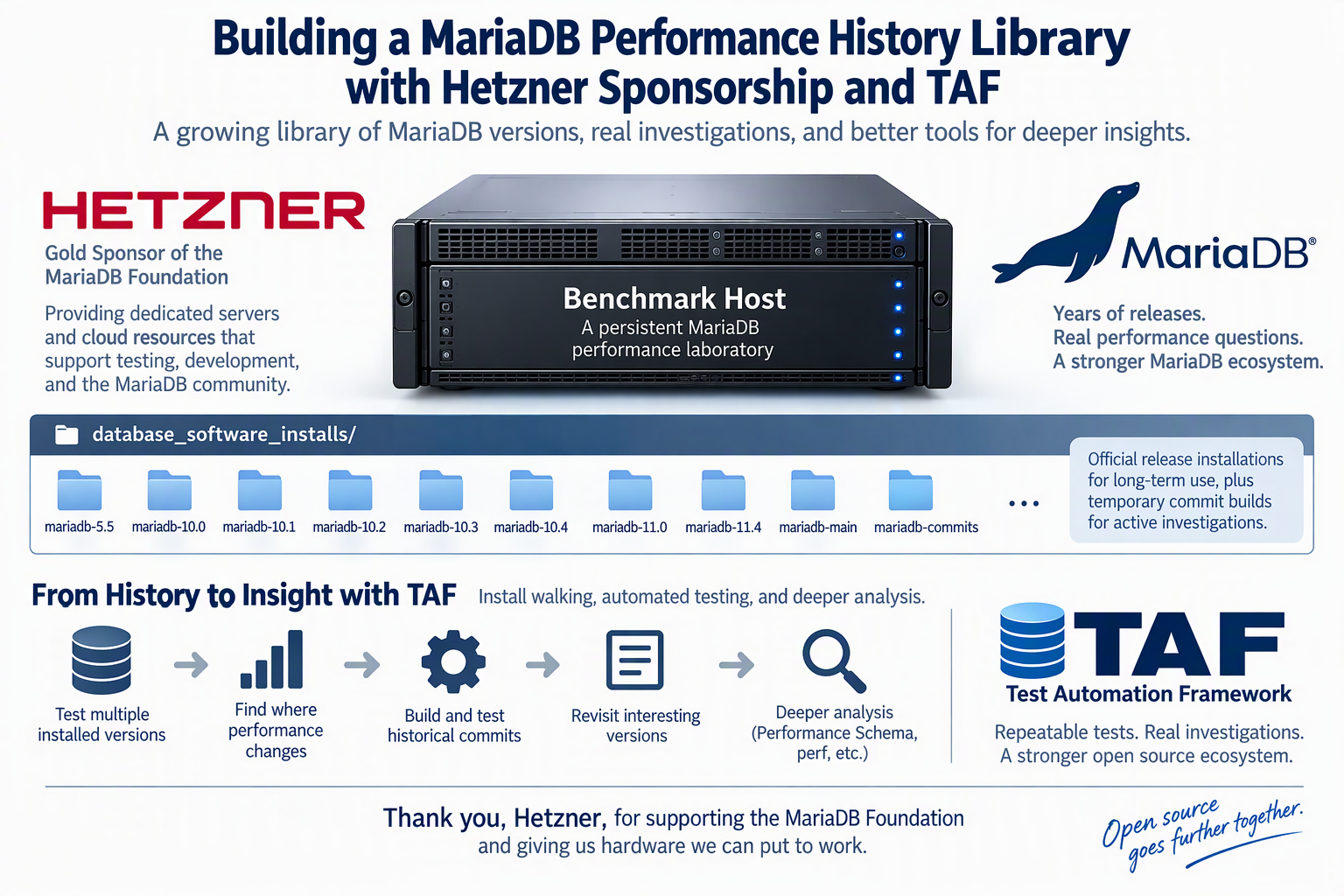
Performance testing becomes much more useful when the infrastructure used for one investigation helps with the next one.
Over time, the benchmark host I use for TAF has accumulated a large library of MariaDB installations covering years of releases.
The library was not created specifically for one performance investigation. It has grown as different test cases and performance questions required different MariaDB versions.
That investment is starting to pay off in ways I did not originally anticipate.
When I receive an older MariaDB performance issue to investigate, much of the first test matrix may already be installed and ready to use.
https://github.com/MariaDB/TAF
Hetzner’s Support Makes This Possible
Hetzner is a Gold Sponsor of the MariaDB Foundation. Hetzner provides dedicated servers and cloud resources that support the Foundation’s infrastructure, testing, and development work.
For my performance work, access to a dedicated benchmark host means more than having a powerful machine on which to generate benchmark numbers.
The host is becoming a persistent MariaDB performance laboratory.
Instead of installing a version, running a test, and throwing the environment away, I have generally kept the official MariaDB installations. The result is a growing collection of releases spanning years of MariaDB development.
The more historical performance investigations I do, the more useful that collection becomes.
Building a Library of MariaDB History
The current installation library contains releases across many MariaDB series, including older releases needed for historical investigations and current development releases.
Mixed into the library during an active investigation are historical commit builds produced while narrowing performance changes.
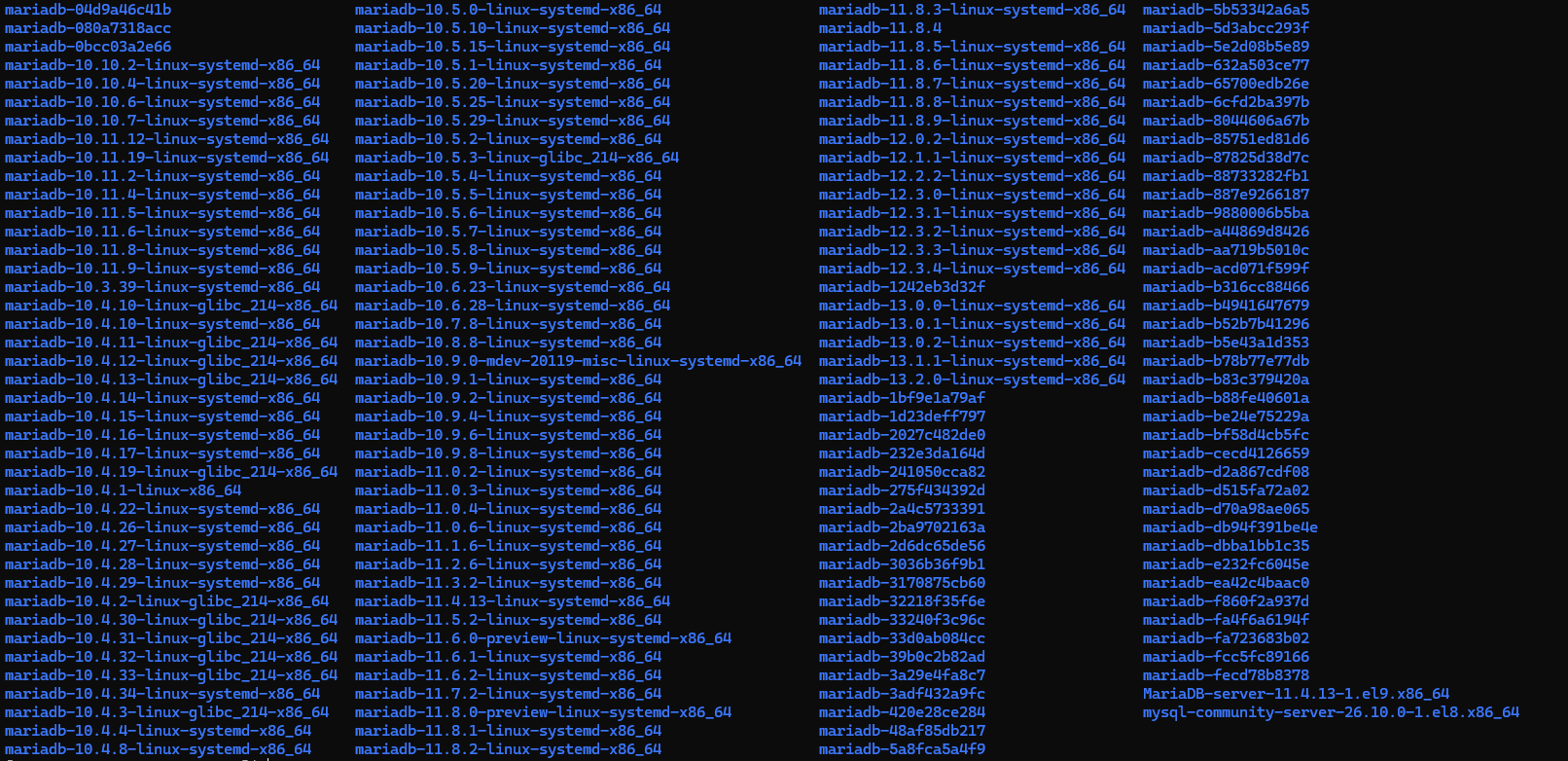
The screenshot above is the current database installation library on the benchmark host.
I normally remove the temporary commit builds after an MDEV investigation is complete while allowing the official release collection to continue growing.
That distinction is useful.
The release installations become the long-term performance history library.
Commit builds are temporary tools for examining the interesting spaces between those releases.
Coming to TAF: Walking Installed Versions
Having many versions installed is useful.
Manually switching between them is not.
A new TAF capability grew directly out of these historical investigations: install walking.
This capability has not been released yet. It is currently being tested against real MDEV performance investigations and is planned for an upcoming TAF release.
The new action currently under test is:
- taf.action=walk-installs-init-start-db-run-tests
The idea is simple.
Give TAF a selected list of already available database installations and let TAF walk through them, performing the repetitive work needed to run the same workload against each one.
For example:
- taf.installs_to_walk=mariadb-11.4.13-linux-systemd-x86_64,mariadb-11.8.9-linux-systemd-x86_64,mariadb-12.3.4-linux-systemd-x86_64,mariadb-13.0.2-linux-systemd-x86_64
Instead of manually changing from one MariaDB installation to another, initializing the database, starting it, running the workload, collecting the results, and then doing the same thing again with another version, TAF handles that repetitive investigation work.
That changes how I can approach historical performance investigations.
Instead of treating every old release as a separate manual benchmarking exercise, I can first run a broad investigation across selected versions and look for where performance changes.
The interesting areas can then receive much deeper attention.
Broad First, Deep Later
This is becoming an important part of the investigation workflow.
The first pass does not need every diagnostic tool enabled.
It primarily needs to answer one question:
Where did performance change?
Once an interesting release boundary is identified, I can narrow that area further with historical commit testing.
Coming to TAF: Build and Test Commits
This is another new TAF capability currently being tested against real MDEV performance investigations.
It has not yet been released and is planned for an upcoming TAF release.
TAF under development can build selected historical MariaDB source commits, retain the resulting builds as database installations, and run the same workload against them.
The action currently under test is:
- taf.action=build-commits-run-tests
A properties file can define the commits to investigate:
- taf.commits=123abc,456def,789abc
TAF then uses its configured MariaDB commit builder to build the selected source commits and make the completed builds available to the normal TAF test lifecycle.
Note: The builder is a plugin shell script. Shell scripts to build MySQL and PSQL can be added.
This allows an investigation to move from release-level history into the source history between releases without changing the workload or surrounding test methodology.
The two new capabilities work particularly well together.
Install walking can establish the broad performance history across existing releases. Commit building can then fill in the interesting gaps once a release boundary has been identified.
Once an interesting version or commit has been identified, I can return to that existing installation later and collect heavier diagnostic information such as Performance Schema data or Linux perf profiles.
The important part is that the earlier installations are still available.
Once TAF has an installation it can run, an official release and a historical commit build can both become useful investigation targets.
That saves a considerable amount of repetitive setup work.
A Host That Becomes More Useful Over Time
This may be the part I find most interesting.
Every official release I keep potentially reduces the setup work required by a future investigation.
An installation downloaded for one performance question may become useful months later for something completely unrelated. As the collection grows, more historical release boundaries are already available when a new MDEV arrives.
TAF then provides the automation needed to turn that collection into something more useful than a directory full of old database installations.
The releases provide the history.
TAF provides the repeatable way to walk through that history.
Commit builds fill in the interesting gaps.
And the deeper diagnostic tools can be saved for the places where the broad testing says they are actually needed.
The Hetzner Performance Hunting Ground
Investigations like these require hardware where I can repeatedly run the same workload while changing the underlying software.
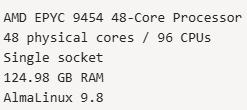
For this work, testing is being performed on a Hetzner Sponsor Host provided to the MariaDB Foundation:
Open source performance work needs more than software.
It needs hardware on which questions can be tested, results reproduced, regressions narrowed, and improvements measured.
Hetzner’s sponsorship of the MariaDB Foundation is providing infrastructure that helps make that work possible.
For the MDEV performance investigations I am doing with TAF, that support is becoming something particularly valuable: a growing laboratory for exploring MariaDB performance across MariaDB’s history.
Thank you, Hetzner, for supporting the Foundation!
To all, “Happy benchmarking!”

Jonathan (Jeb) Miller has experience in military leadership, Fire/EMS leadership, computer operations leadership, teaching, and more than 27 years of database performance engineering (PervasiveSQL, MySQL, MariaDB).
TAF is the third benchmarking framework he has helped design and build.
#Hetzner #MariaDB #MySQL #PostgreSQL #Database #TAF #DatabasePerformance #Performance
Leave a Reply