
Category: Generic
-
MariaDB Foundation: Reproducing and Validating MDEV‑37992 with TAF
Thanks to Mark Callaghan for filing MDEV‑37992. This regression only appears under specific LRU and buffer‑pool conditions, and requires a memory‑resident workload to expose.
Using TAF, I reproduced the issue across 11.8, 12.3, and 13.1 using both parent commits and patched commits from MDEV‑33966. The fix restores expected throughput in all branches.
The workload used was POINTS‑COVERED‑PK with 10M rows × 8 tables, 40 threads, warmup enabled, and a 90G buffer pool. TAF’s warmup iteration, rest detection, and stable‑state perf […]
-
Building a Public Performance Change Detection Library for MariaDB
Performance engineering inside a database project is usually private. Teams run internal workloads, investigate changes, fix issues, and move on. The knowledge stays inside the company, and the outside world only sees a benchmark graph or a release note.
I know this pattern well — I spent more than twenty‑six years doing this work for both PervasiveSQL and MySQL.
The investigations were deep, the lessons were real, but almost none of it was visible to the outside world.
The surprises, […]
-
Open Source milestone – MariaDB’sEcosystem hub hits 200 solutions
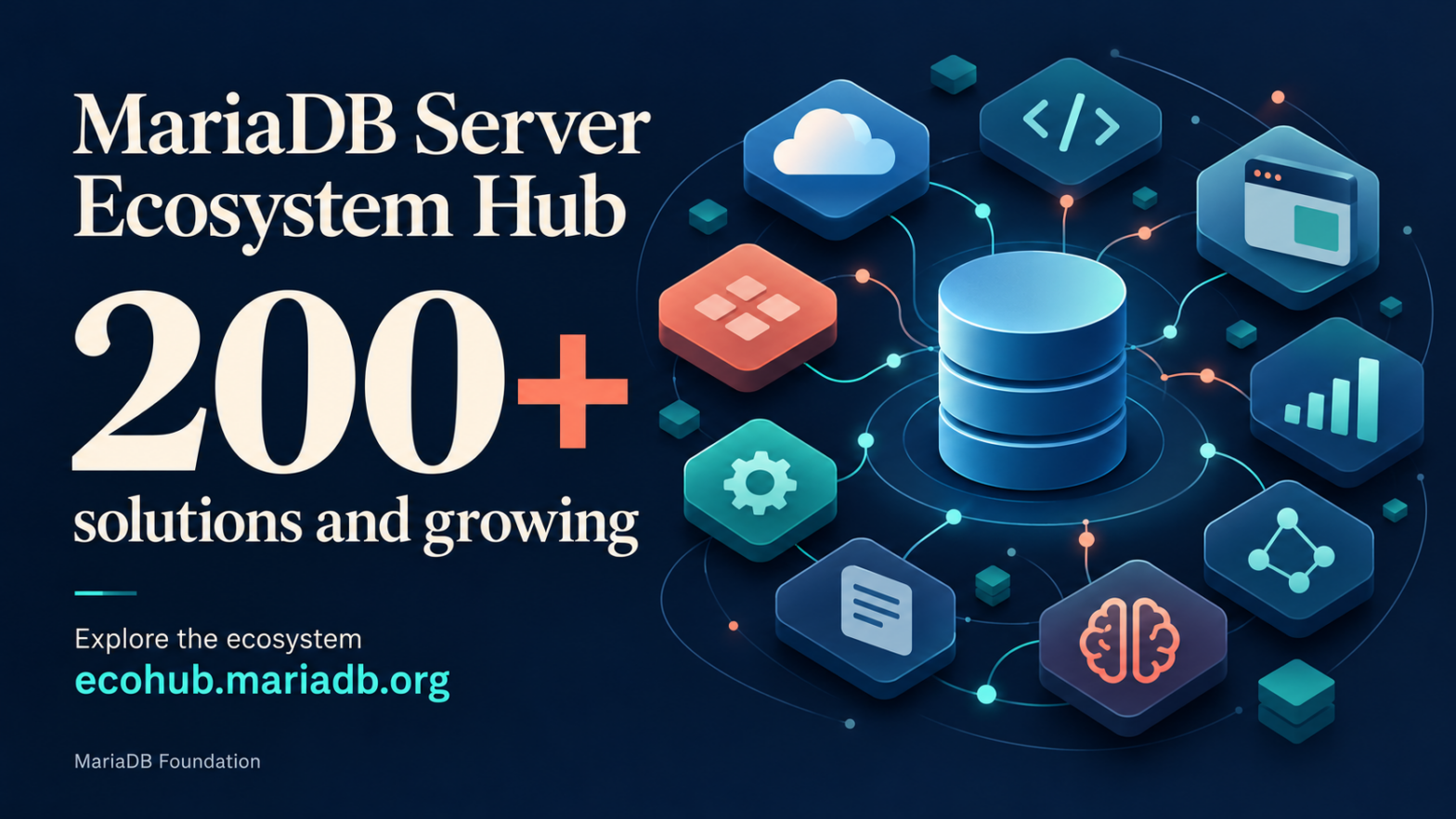
New ‘App store of open source’ is one stop shop serving the fast-growing MariaDB community’s needs for applications, developer tools, cloud platforms and projects.
The MariaDB Foundation today announces the MariaDB Server Ecosystem Hub has exceeded 200 entries, just six months after launch.
The Hub is a curated, open directory of MariaDB Server approved products, services and open-source projects. The ecosystem spans cloud and hosting platforms, monitoring and observability, backup and recovery, security, migration, connectivity, DevOps, analytics, AI and application […]
-
MariaDB Foundation Adds PostgreSQL to Its Engine‑Agnostic Testing Framework (TAF).
The Test Automation Framework (TAF) was designed so that database makers themselves could create a plugin and integrate their database engine directly into the framework.
TAF provides the structure — lifecycle management, workload execution, profiling, reporting, and reproducible properties files — and each database plugin supplies the engine‑specific logic.
The first two plugins added to TAF were MariaDB and MySQL, proving the model: database vendors can plug their engine into TAF and immediately gain automated installs, structured workloads, concurrency sweeps, […]
-
MariaDB Foundation: Auto‑Generated User Properties in TAF 4.0 — The Piece for Ensuring Full Test Reproduction
TAF’s reproducibility story just gained its most important upgrade: every test case now produces a fully resolved, auto‑generated user properties file.
This file captures exactly what the run used — not what the user intended, not what was passed in, but the final, authoritative configuration TAF executed. It removes ambiguity, eliminates hidden dependencies, and makes every test case a fully self‑describing artifact.
This feature builds directly on the work introduced in the previous blog, where TAF gained support for embedding […]
-
MariaDB Foundation: TAF Now Supports Embedded Database Configuration in User Properties
TAF: One File to Rule Them All
In a one‑on‑one review of TAF with Monty Widenius, the creator of MySQL and MariaDB, he looked at me and said: “I want everything in one user file.”
It was simple, direct, and completely right direction.
TAF’s configuration model had inherited its design from older frameworks — a user properties file and a separate database configuration file.
Monty’s comment cut straight through it. He wanted simplicity — one file that defines everything.
So […]
-
MariaDB Foundation: Why Test Case Tags Matter in TAF
In performance testing, numbers alone rarely tell the full story.
A benchmark result without context is just a result floating in space disconnected from the intent, and the conditions that produced it.
For the MariaDB Foundation, where transparency and reproducibility are core principles, this isn’t good enough.
Before diving into the details of the TAF 4.0 test-case-tag properties, the Foundation appreciates your input in the MariaDB Foundation Annual Survey
Back to test-case-tags, TAF treats the test case tag as a […]
-
MariaDB Foundation’s Test Automation Framework (TAF) 4.0 Release
MariaDB Foundation’s Performance Test Automation Framework (TAF) 4.0 Release represents the biggest changes to the framework since its creation.
This release reshapes how we organize, run, and report database workloads across MariaDB, MySQL, and now PostgreSQL.
The improvements are not just incremental — they fundamentally change how results are collected, tagged, and analyzed across the entire automation pipeline.
Several of the changes in TAF 4.0 were driven directly by requests from Monty, the creator of both MySQL and MariaDB.
Monty’s […]