
MariaDB Foundation Newsletter – 15 November 2026

Atarim has moved the vector store behind its production RAG system from Qdrant to MariaDB, and its write-up is candid about what worked, what needed rethinking and where Qdrant still wins. Also this fortnight: optimizer hints in MariaDB Server 13.0, TLS connections more than three times faster on Apple Silicon builds, a new way to measure what each server feature costs, our first India meetup, and a conversation with the security researcher behind more than 90 reports on MariaDB’s connectors.
Atarim moves its RAG storage from Qdrant to MariaDB
Atarim, an AI web agency that runs ongoing site care for its clients’ websites, gives its AI agents each client’s context through a RAG system. It has replaced Qdrant with MariaDB as that system’s vector store. Embeddings and their metadata now live together in MariaDB 11.8 on Amazon RDS, the first LTS release with MariaDB Vector, and vector search and filtering run as SQL over one connection. The team describes the switch as close to a direct replacement.
The article is candid about what it took. Every Atarim search is limited to one client workspace, and with the HNSW index MariaDB found the nearest neighbours first and filtered afterwards, so too few results came back. Narrowing the candidates with indexed virtual columns and scoring them exactly fixed both recall and latency, and the team now sees that ability to filter with SQL before scoring as MariaDB’s main advantage for its workload. On unfiltered searches, which Atarim does not run, Qdrant was faster and more accurate. A follow-up article will test both stores at 50 times today’s data size.
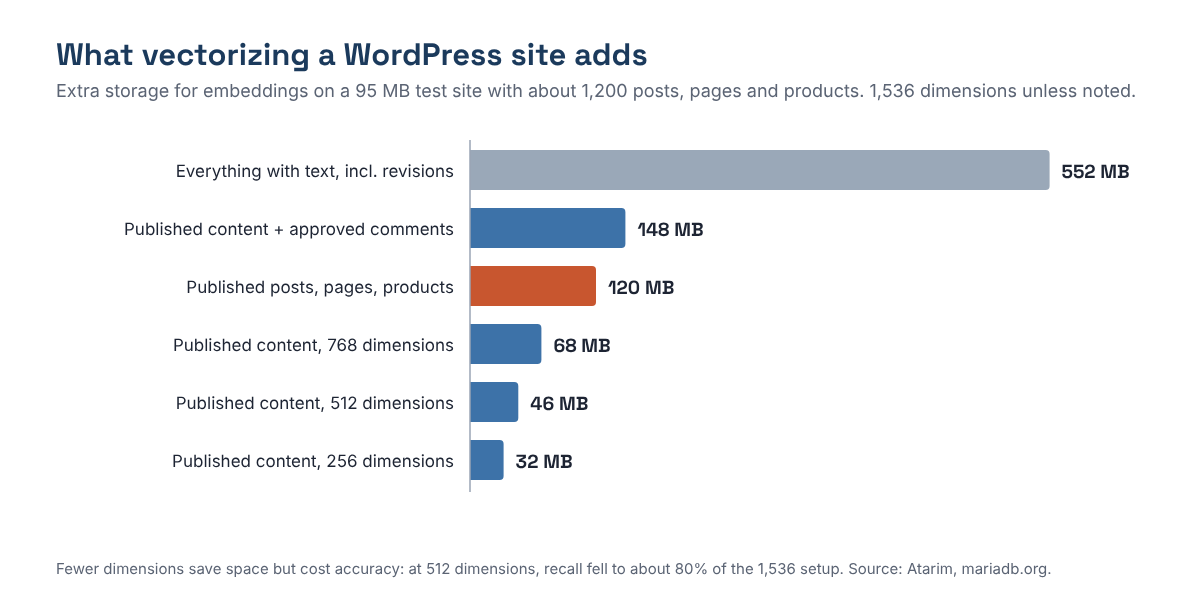
The article also measures what it would cost to vectorize a WordPress site’s own content: on a 95 MB test site, published posts, pages and products added 120 MB at 1,536 dimensions, and 46 MB at 512.
Atarim on MariaDB Vector: Moving RAG Storage from Qdrant to MariaDB →

FOSDEM 2027 · Call for participation
Two weeks left to submit to the M-ecosystem devroom
The devroom runs on Sunday 31 January at ULB Solbosch, Brussels, with talks of about 20 minutes on MySQL, MariaDB, Percona Server, VillageSQL, AliSQL and the tools and connectors around them. Proposals close on 29 November; selected talks are announced by 7 December. MySQL Belgian Days (28 to 29 January) takes proposals until 30 November. Details in lefred’s call for participation.
Our first India meetup: Marina, the DuckDB engine and a GSoC story
On 12 November we held the MariaDB Foundation’s first India meetup, online, and the audience got an early look at work in progress.
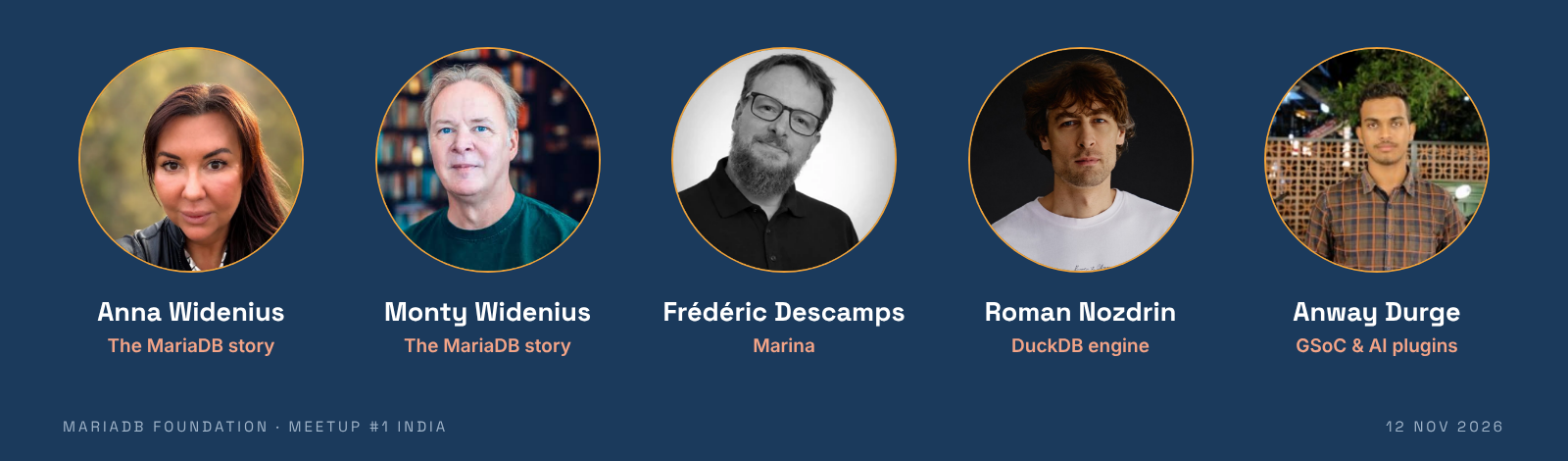
Marina explores how MariaDB plugins could be found, checked and installed as easily as packages on Linux. Frédéric Descamps (lefred) walked through the idea: catalogs of signed plugins that you search and install from directly in SQL, with clear signals about how far each plugin has been reviewed. In a live demo, he installed a plugin from a catalog with a single SQL statement. The work is at an early stage, and we will share more as it takes shape.
The DuckDB storage engine lets MariaDB hand a whole analytical query to DuckDB and return the result, while MariaDB keeps the client protocol, metadata and privileges. Roman Nozdrin showed queries joining InnoDB and DuckDB tables in one instance, with no second copy of the data. On a Magento full-orders report with synthetic data, the report took 18 seconds with both tables in InnoDB and ran about 63 times faster with both in DuckDB. The plugin is built and waiting for the next MariaDB release.
From GSoC to the codebase. Anway Durge, our GSoC 2026 contributor from Bengaluru, made simple INFORMATION_SCHEMA queries stream rows straight to the client instead of filling a temporary table first: 78 ms down to 31 ms on a 2,000-row test, and flat as rows grow. He now uses the MariaDB AI plugins to connect skills, the MCP server and mariadb-shell to his IDE.
Anna and Monty Widenius opened with the MariaDB story, from MySQL’s first licence to the fork, and how the Foundation works today: every external contribution gets a first response within seven days and a human review. In the Q&A, Monty advised a founder to choose GPL for embeddable products and BSL for tools, and never open core.
Fix the class, not the instance: hunting bugs in MariaDB’s connectors

Yalguun Tumenkhuu fg0x0
Cyber Security Lead, Khan Bank · HackerOne Brand Ambassador for Mongolia
Yalguun Tumenkhuu, known online as fg0x0, is a security researcher in Mongolia, Cyber Security Lead at Khan Bank and HackerOne Brand Ambassador for Mongolia. In our interview, Yalguun walks through what turned up in MariaDB’s connectors: SQL injection through client-side escaping that mishandles multi-byte character sets, credentials sent in cleartext during authentication, memory sizes taken from the network without checks, and an R2DBC case where one injected packet could make the driver return one user’s rows to another.
The lesson in the title is for maintainers: when a security report lands, search for the same pattern everywhere before closing the ticket. Yalguun also shares advice for researchers on working with triage teams, and for projects: publish a SECURITY.md, name one reporting channel and state your threat model.
Ecosystem Hub
Is your project in the Hub yet?
Tools, applications, hosting services and solution stacks that work with MariaDB Server. Submissions are free and reviewed by the Foundation.
Hints, handshakes and the price of a feature
Giving the optimizer a hint in MariaDB Server 13.0
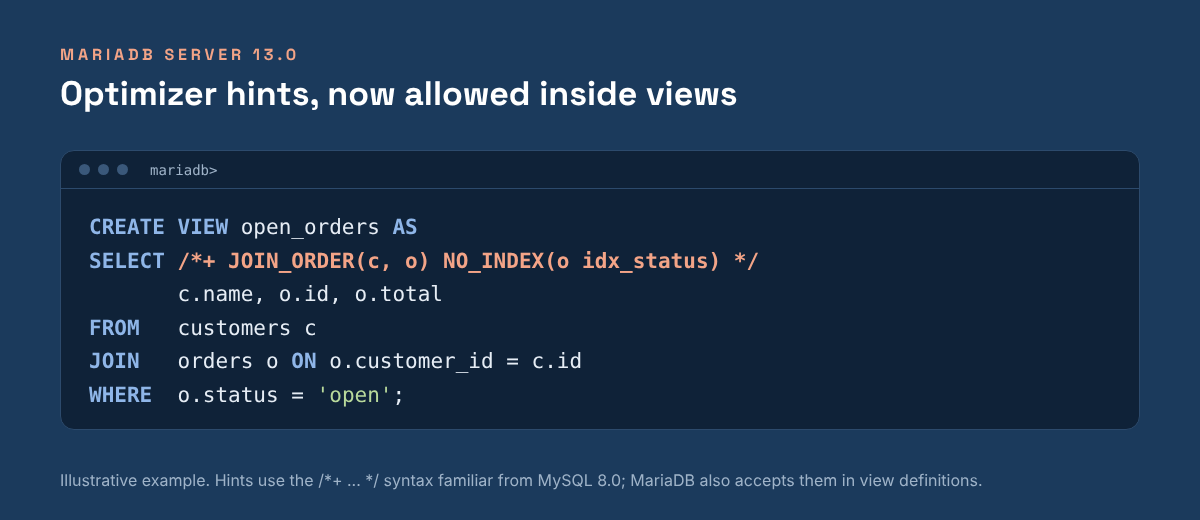
MariaDB Server 13.0 ships a full set of optimizer hints, so you can tell the optimizer what you know about your data. Hints go in /*+ ... */ comments, in the style MySQL introduced in 8.0, and cover join order, index use, join buffers, derived-table merging and condition pushdown, subquery strategies, MRR, ICP, range optimization, rowid filtering and maximum execution time. MariaDB goes further than MySQL in two places: any hint except MAX_EXECUTION_TIME can live inside a view definition, and hints can address query blocks without QB_NAME, through implicit names and explicit paths into views, derived tables, CTEs and subqueries. The guest post is by Oleg Smirnov.
Giving the Optimizer a Hint (9 Nov) →
TLS connect and disconnect, more than 3× faster
WolfSSL has faster big-number code for compilers that support 128-bit integers, but MariaDB’s WolfSSL configuration never checked for it and fell back to slower portable code. Georgi Kodinov added the missing check. So far the gain has been seen only on Apple Silicon Macs; the work is tracked as MDEV-42175.
TLS Connect/Disconnect Performance Boost With WolfSSL (13 Nov) →
TAF: what does each feature cost in throughput?
The Foundation’s Test Automation Framework now has targeted performance profiles. Each changes one setting and runs the same workload, sized to fit the buffer pool, so you can see what binlog variants, InnoDB doublewrite and flush settings, isolation levels, Performance Schema levels, the thread pool, character set conversion, logging or SSL cost on your own hardware. The idea started with Monty in MDEV-39497, and Jonathan Miller turned it into a reproducible suite. The aim is measurement, not tuning advice. In a follow-up, Jeb describes preparing TAF for large AMD EPYC hosts, to measure how throughput grows from 4 to 96 vCPU and where it levels off.
Profiling MariaDB Subsystems Across Hardware (9 Nov) → From Big Iron to AMD EPYC (16 Nov) →
A whole analytic data type as a plugin
Can a complete analytic feature live outside the server core? After building type_hll, Roman Nozdrin’s answer is “mostly yes”: one shared library adds a HyperLogLog column type, two aggregate functions and six scalar functions for fast approximate distinct counts. It currently needs a server built from a development branch, as pluggable aggregates arrive officially in MariaDB 13.3, and Roman lists the remaining limits openly. In the same spirit, the Plugin API now has a Doxygen reference, generated from the server headers and refreshed nightly; Georgi Kodinov asks plugin authors which APIs to document next.
luroConnect joins as a Silver Sponsor

 SilverluroConnect joins as Silver Sponsor (3 Nov). luroConnect runs managed eCommerce hosting for Magento and Adobe Commerce merchants, deployed into customers’ own AWS or GCP accounts, with MariaDB in production underneath. You may remember its 500 GB RDS-to-EC2 migration story from our 15 October issue. Announcement
We run MariaDB in production for eCommerce stores, where the database often decides whether a checkout holds under load.Pradip Shah, Co-Founder and CEO, luroConnect
SilverMariaDB and WordPress on Kamatera. (3 Nov) lefred built a demo project that deploys WordPress with MariaDB on Kamatera using OpenTofu. One variable switches between a single VM and a separate MariaDB VM on a private network. It is meant for learning, not production. Read
Thank you to all our sponsors: your support keeps MariaDB Server independent and community-led.
A quiet fortnight for releases
No MariaDB Server release shipped in the first half of November. The coming maintenance releases will carry the InnoDB in-memory fix from our last issue.
From MariaDB plc
MariaDB Enterprise Platform 2027. (4 Nov) MariaDB plc released Enterprise Platform 2027, built on MariaDB Enterprise Server 12.3 with MariaDB Exa, MariaDB GridGain, MaxScale, Enterprise Manager and the Enterprise Kubernetes Operator, and launched a new brand the same day. A webinar introducing the platform runs on 18 November. Read
Percona
PerconaHeavy reports in seconds, on a MariaDB source. (10 Nov) Vadim Tkachenko returns to dbtrail, an Apache-licensed project that follows a MySQL-compatible server like a replica and keeps a columnar copy for heavy reports. It supports MariaDB 10.11 and later. In dbtrail’s own test on a MariaDB 10.11 source, application p95 latency stayed at 13.2 ms with reports running through dbtrail, against 6,960 ms with the reports on the database itself. Read
PerconaRe-evaluating Galera node weights. (13 Nov) Marco Tusa revisits node weights in Galera-based Percona XtraDB Cluster. Read
| Date | Event | Location |
|---|---|---|
| 19–20 Nov 2026 | DrupalSouth Community Day, with a talk by Daniel Black | Canberra, Australia |
| 3 Dec 2026 | Atarim + MariaDB live clean-up | Online |
| 28–29 Jan 2027 | MySQL Belgian Days | Brussels, Belgium |
| 30 Jan 2027 | MariaDB Day Brussels, talk proposals open until 13 Dec | Brussels, Belgium |
| 30–31 Jan 2027 | FOSDEM 2027, M-ecosystem devroom on 31 Jan | Brussels, Belgium |
| 15–18 Mar 2027 | CloudFest Global 2027 | Rust, Germany |
| 27–28 May 2027 | DevOps Pro Europe | Riga, Latvia |
Full listing: mariadb.org/events
Leave a Reply