



MariaDB Foundation Sea Lion Champions Nominees: Federico Razzoli
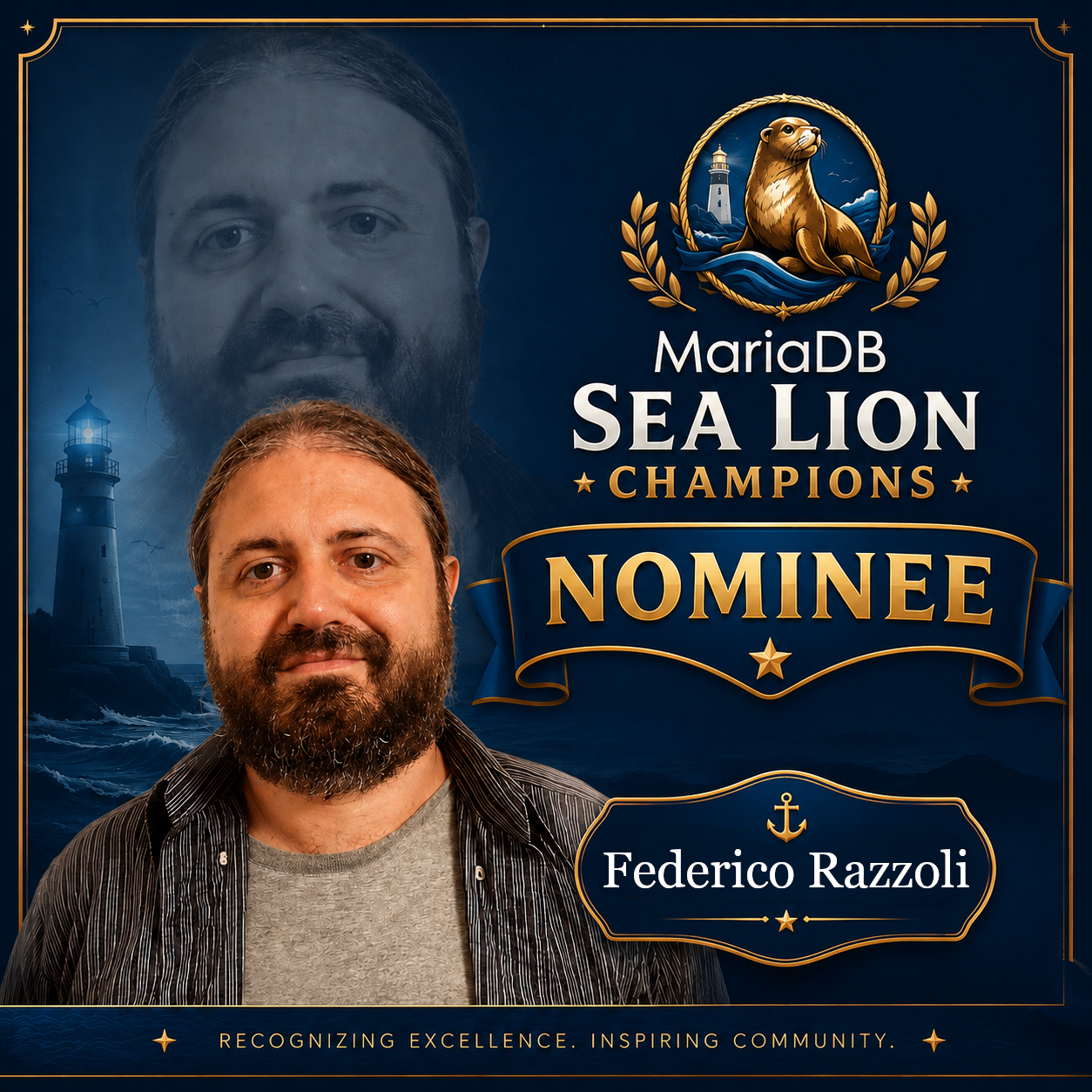
Interview with Federico Razzoli, nominated in the Community Leadership category.
The MariaDB Foundation Sea Lion Champions program celebrates the people and organizations who help make the MariaDB ecosystem stronger, more open, and more useful for everyone.
Behind every open-source project, there are contributors whose work takes many forms. Some write code. Some review, test, document, teach, organize, advocate, support users, build tools, or bring MariaDB into production environments where it proves its value every day. Together, they help MariaDB remain a vibrant, collaborative, and industry-relevant database platform.
To highlight this diversity of contributions, we are launching a new series of interviews with nominees for the MariaDB Foundation Sea Lion Champions program. Each conversation will introduce one nominee, their work, their connection to MariaDB, and the impact they have had on the wider community.
Today, it’s Federico Razzoli’s turn, whose long-standing involvement in the database world, technical writing, community engagement, and support for open-source database users make him a familiar and respected voice in the MariaDB ecosystem.
The Interview
lefred: Ciao Federico, it’s great to finally sit down for this interview. We’ve known each other for a long time, going back to our MySQL and Percona days. You’ve been nominated for the MariaDB Foundation’s “Community Stewardship” award, and it’s clear your heart is increasingly with MariaDB, even though Vettabase works with various databases. Could you tell us a bit about your journey and what draws you to MariaDB?
Federico: Thank you, lefred. It’s a pleasure. I’ve been working with databases since 2000, and after various roles in different companies, I founded Vettabase in 2020. While my personal preference leans towards MariaDB, Vettabase proudly covers MySQL, PostgreSQL, and Cassandra. This diversity is crucial because modern companies rarely use a single database; they need a suite of tools. Our mission is to help them choose the right database for the right occasion and ensure proper data integration.
lefred: I often see your posts about MariaDB on my social media feeds (link to your blog). Is it important for you to share your knowledge?
Federico: Yes, absolutely. For me, it’s essential. As I said, at Vetabase, we don’t just focus on MariaDB, but it’s my personal preference, and I like to showcase some features and solutions.
lefred: You are also a regular speaker at events organized by the MariaDB Foundation, aren’t you?
Federico: Yes, I am. I think it’s important and it’s always pleasant to meet the MariaDB Team and other users. I hope to see the same enthusiasm at future events and to keep participating.
lefred: That’s a very pragmatic approach. We often say that the best database is the one you know, or the one your team knows best. You also mentioned PostgreSQL. What specific use cases do you see where PostgreSQL still has an edge, or covers areas that MariaDB doesn’t yet fully address?
Federico: That’s an excellent question. While I agree that familiarity is key, companies also choose whom to hire based on their technology stack. Regarding PostgreSQL, I believe it generally works better for analytics. It excels at complex queries and joins, offering features such as parallel joins, which are very important for analytical workloads. Its optimizer is also highly regarded, and its extensibility has enabled the community to build a wide array of useful extensions for specific use cases. Another area where it shines is GIS, particularly PostGIS, which is more mature than MariaDB’s current geospatial offerings.
Colmnstore and DuckDB are storage engine oriented analytics that provided even better performance within MariaDB.
Interviewer’s note
lefred: It’s interesting you bring up GIS. This could be a domain where we can improve even more. When I discuss this with people, many mention PGVector as a kind of standard for vector search. However, MariaDB’s vector search implementation is incredibly fast. How do you compare them?
Federico: You’re right, MariaDB’s vector search is very fast. I agree on that. However, PGVector and other extensions in the PostgreSQL ecosystem offer more features. For instance, they support algorithms such as BM25, which are important for some companies. This allows for combining different types of searches – vector search alongside BM25 – to retrieve richer data, which can then be fed to LLMs. Each approach has its strengths, and the choice often depends on the specific requirements for search relevance and data enrichment.
BM25 (Best Matching 25) is a highly effective keyword-based search algorithm that ranks documents by their relevance to a search query. It serves as the standard search engine behind platforms like Elasticsearch, OpenSearch, and Lucene, powering both traditional text search and hybrid AI
Interviewer’s note
PGVector does an hybrid search by combining vector similartity search adn bm25-based fulltext search using reciprocal range fusion.
MariaDB Server supports also hybrid search using reciprocal range fusion just the same way: https://mariadb.com/docs/server/reference/sql-structure/vectors/optimizing-hybrid-search-query-with-reciprocal-rank-fusion-rrf but using a more elaborate weighting function that doesn’t affect the hybrid search.
Interviewer’s note
lefred: That provides a great perspective. Now, shifting gears a bit, you’ve been a strong advocate for open source. How important is the role of the MariaDB Foundation for you?
Federico: For me, the MariaDB Foundation is absolutely essential. Without it, we would have a single company controlling MariaDB. While I appreciate the work of MariaDB plc, a single-company control always presents a risk. The Foundation ensures that MariaDB remains truly open source. It’s vital to have an entity that genuinely cares about open-source principles, understands the community’s needs, drives adoption, and ensures everything remains open. While other models exist, like PostgreSQL’s “purer” foundation, they also have their drawbacks. The MariaDB Foundation provides a crucial balance and safeguards the project’s future.
lefred: I couldn’t agree more. Thank you, Federico, for these insightful answers. It’s clear that your dedication to the open-source community and your balanced view on database technologies are invaluable.
