

Category: Vector
-
Atarim on MariaDB Vector: Moving RAG Storage from Qdrant to MariaDB

Atarim has replaced Qdrant with MariaDB as the vector store for its internal RAG system. The team describes the change as close to a direct replacement, made for easier integration, data sovereignty and fewer vendors to manage. Vectors and their metadata are now stored in a single relational database on AWS, and filtered searches in production return in about 10 ms.
Atarim is an AI web agency that uses AI-powered workflows to handle ongoing site care for its clients’ websites. […]
-
Build an “ask the docs” app with Laravel 13 and MariaDB Vector
Earlier this month we wrote that Laravel 13 now supports MariaDB Vector natively. Mohamed Touhami Rhaima, one of the community contributors who made that happen, has now written a tutorial on how to use it, and recorded a video version.
Why MariaDB Vector in Laravel
With Laravel 13 and MariaDB 11.7 or later, you can store embeddings and search them by meaning in the same database as the rest of your application data, using the framework’s own database features.
This […]
-
Laravel 13 now supports MariaDB Vector natively
If your Laravel application runs on MariaDB, you can add semantic search to it without a second database, an external vector service or an extra package. Since Laravel 13.28, vector columns, vector indexes and similarity queries work on MariaDB out of the box. A large part of that work came from community contributors, including Mohamed Touhami Rhaima.
Until this summer, Laravel’s built-in vector search was a PostgreSQL feature: it assumed pgvector. Laravel’s AI SDK documentation now reads: “Vector queries are currently supported on […]
-
MariaDB Vector in Laravel: insights on choosing an embedding model
Update, October 2026: Since Laravel 13.28 (August 2026), vector columns, vector indexes, the AsVector cast and vector similarity queries on MariaDB are built into Laravel itself, with no package needed. See Laravel 13 now supports MariaDB Vector natively. Erik’s package remains an option for Laravel 12, and his findings on choosing an embedding model apply whichever you use.
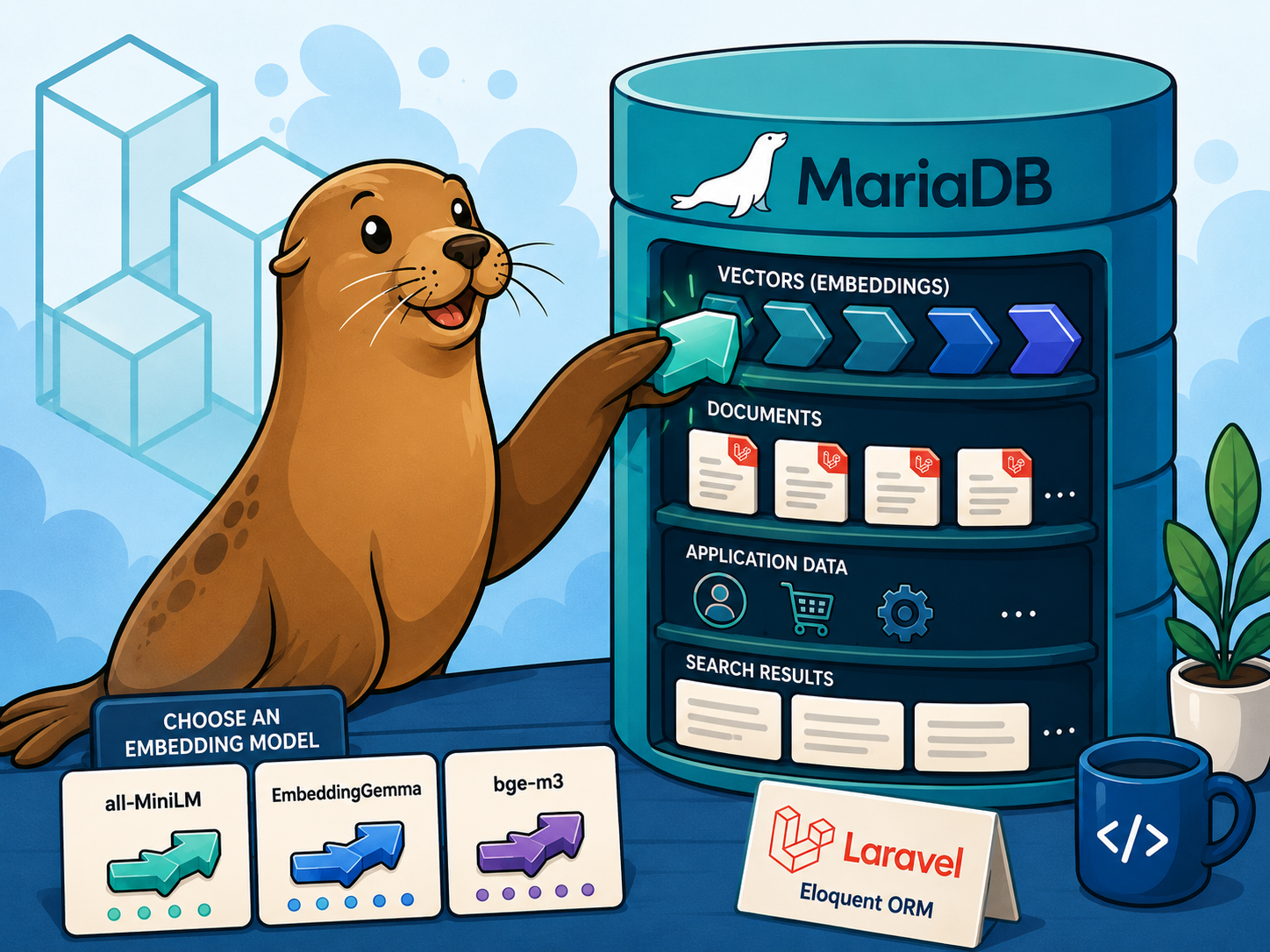
laravel-mariadb-vector is an open-source project by Erik Ros, bringing MariaDB’s native vector search to Laravel’s Eloquent ORM. In his guest post, Erik shares how it works, and […]
-
MariaDB Vector: How it works. Part IV

This is the last post in the “MariaDB Vector: How it works” series. The first three were about storage, in-memory representation, HNSW modifications. Everything that was done in MariaDB 11.8. This post talks about new feature in MariaDB 12.3: optimized distance calculation.
MathJax = { output: { linebreaks: { inline: false } } }
As I mentioned earlier, distance calculation is the most time consuming part of the vector search, taking 80–90% of the total search time. Also it is […]
-
MariaDB Vector: How it works. Part III

In the previous parts of this series we’ve seen how MariaDB stores vector indexes in a table and how to implement HNSW for a good performance. But MariaDB is not implementing HNSW, it calls its vector search algorithm mHNWS, a modified HNSW. Let’s see how exactly it was modified.
MathJax = { output: { linebreaks: { inline: false } } }
Not so greedy!
HWNS, like many, if not most, graph based vector search algorithms is greedy. Think of it […]
-
MariaDB Vector: How it works. Part II

In the first post of this series, I’ve described how the vector index is stored in a table and how it achieves full transactional behavior and ACID properties compatible with the storage engine of the table the user created. But while the table provides persistent storage of the index, it’s in-memory part that gives it the performance. This is how it works.
Distance calculations
This is the most performance sensitive part of the HNSW. According to various estimates, distance calculations […]
-
MariaDB Vector: How it works

You might have seen that MariaDB Vector is fast. And is getting faster. But why? How does it achieve that? And why it is said to use mHNSW (modified HNSW) algorithm? What did it modify in the conventional HNSW that all other databases are using? Let’s take it apart and analyze piece by piece.
Introduction into HNSW
This post is not a full description of HNSW, there are many HNSW descriptions online and they are good, better than what I […]