
Category: Foundation
-
MariaDB Foundation is pleased to welcome Auree as a Silver Sponsor.
Auree is building a cloud-independent platform for deploying and operating highly available open source databases, including MariaDB, inside customers’ own cloud accounts. Its Bring Your Own Cloud model allows organisations to choose their cloud provider, region, infrastructure size, and security environment while Auree automates database provisioning, monitoring, backups, clustering, and failover.
This approach addresses a growing concern among organisations adopting managed database services: how to gain the operational benefits of the cloud without surrendering control of their data, infrastructure, or […]
-
Hear Ye, Hear Ye: A Guide to MariaDB’s Governance Model
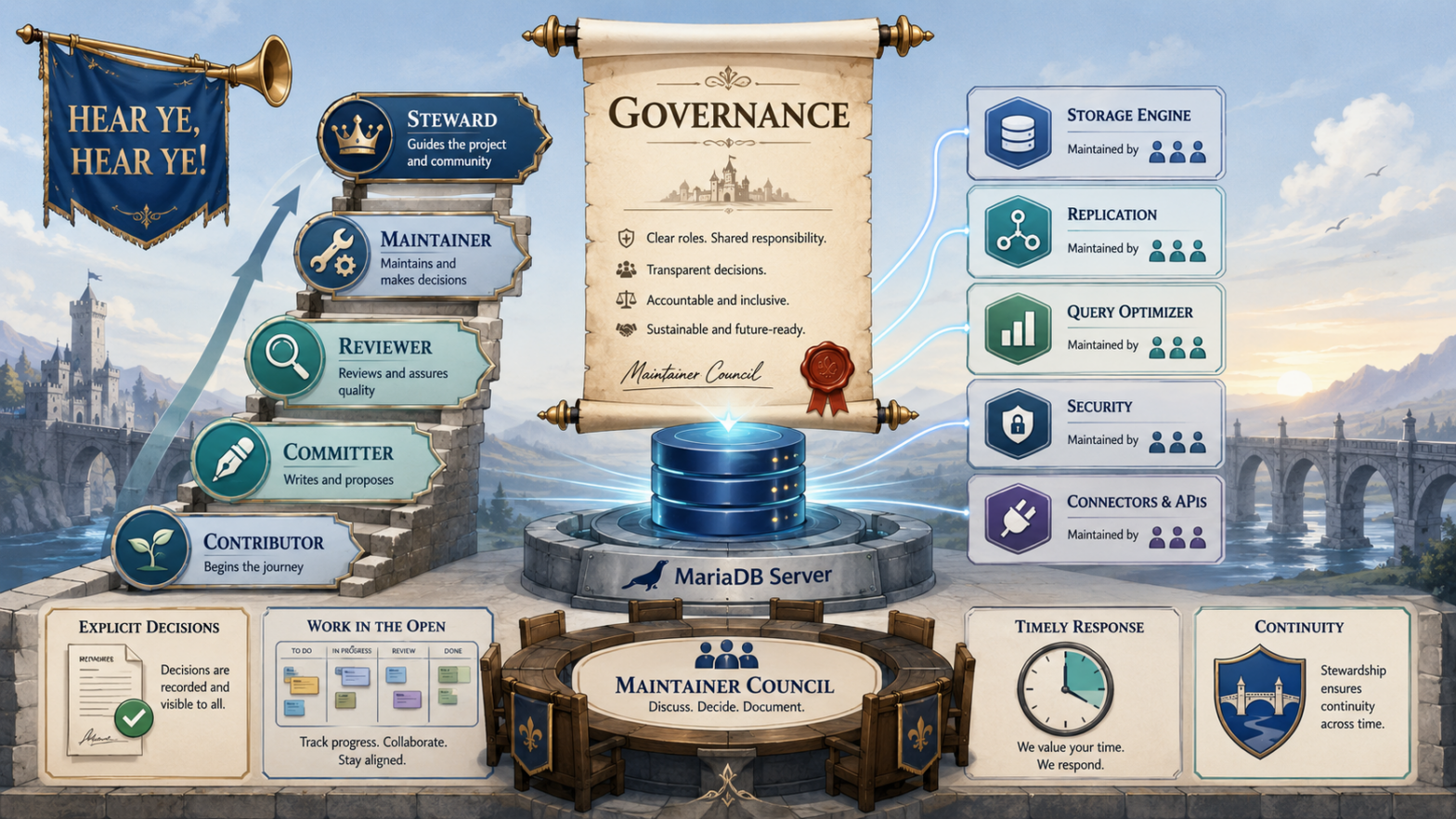
Be it known: MariaDB Server now has a clearer, publicly documented governance framework covering technical roles, subsystem ownership, decision-making, response expectations and continuity.
Open source begins with access to the code. Yet for infrastructure expected to remain dependable for many years, openness must also extend to how responsibility is assigned, how decisions are made, and what happens when people disagree or move on.
The framework formalises much of how the project has long worked, while making its responsibilities, decision paths […]
-
Continuent joins MariaDB Foundation as a Silver Sponsor
MariaDB Foundation is pleased to welcome Continuent as a new Silver Sponsor.
Continuent develops solutions for organizations running business-critical applications on MariaDB and other MySQL-compatible databases. Its flagship product, Tungsten Cluster, helps organizations manage database availability, disaster recovery and distributed deployments across on-premises, cloud and hybrid environments.
The company has worked with open-source database technologies for more than two decades and brings extensive experience from demanding production environments across SaaS, financial services, telecommunications, e-commerce and other industries.
“Continuent has a […]
-
Aqtra Joins MariaDB Foundation as a Gold Sponsor
MariaDB Foundation is pleased to welcome Aqtra Platform as a new Gold Sponsor.
Aqtra is a Development Infrastructure Layer (DIL) platform for building ERP solutions, business applications, internal and external portals, and workflows that connect multiple systems. The platform provides the underlying architecture, governance, integration, and runtime capabilities required to develop and operate business applications at scale, helping organisations automate complex processes without building and maintaining every application from scratch.
As part of the next stage of its platform evolution, […]
-
MariaDB Foundation Sea Lion Champions Nominees: Sumit Srivastava
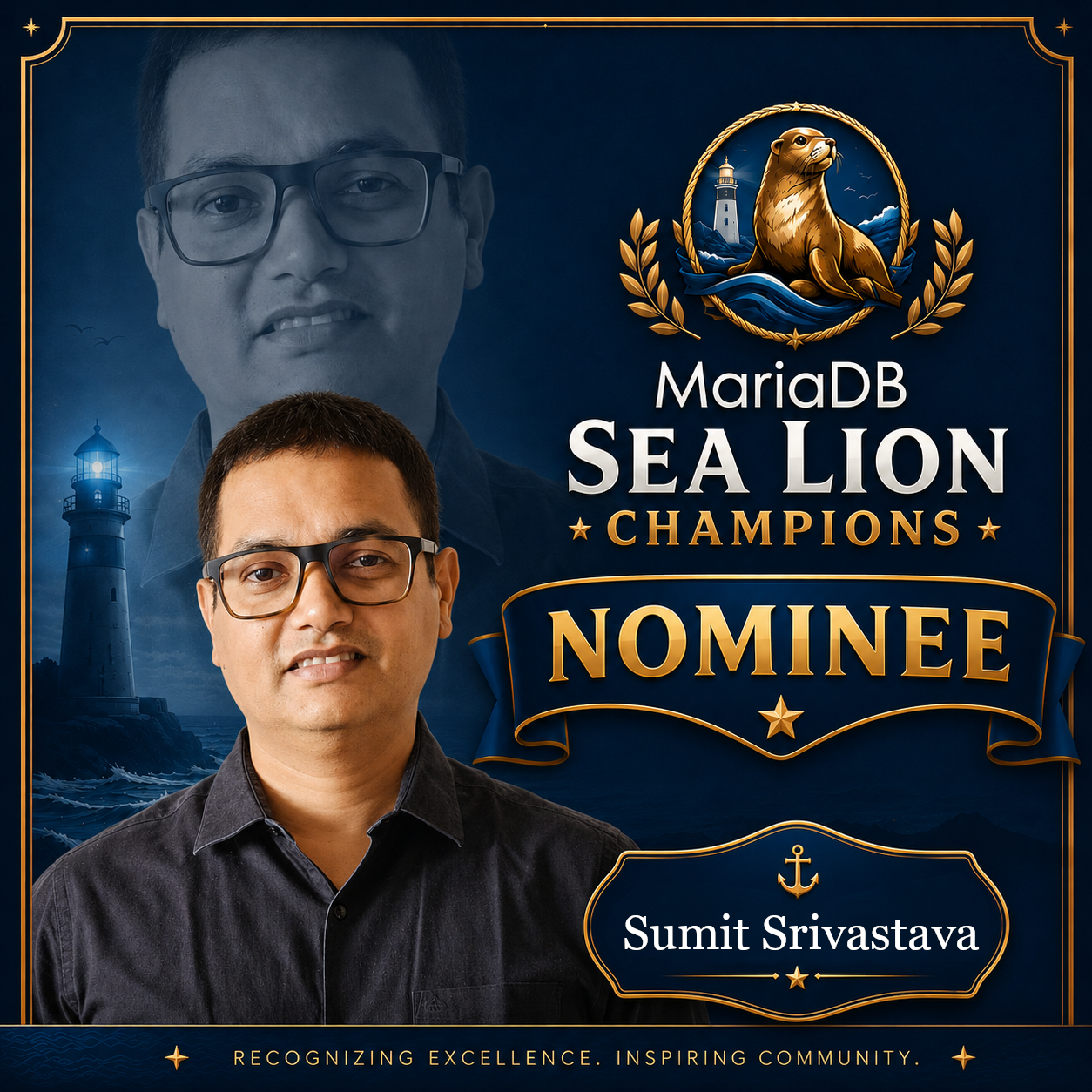
Interview with Sumit Srivastava, nominated in the Adoption & Industry Impact category.
I had the pleasure of speaking with Sumit Srivastava, SVP Business Development & Products at Tayana, a Bangalore-based telecom software company. Sumit was nominated for championing MariaDB adoption in the telecommunications industry and its demonstration of open-source database delivering performance, scalability, and business impact in mission-critical systems. Like me, Sumit sits between technical and business — “the business people think I’m technical, and the technical people think I’m […]
-
MariaDB Foundation at Oracle’s MySQL Contributor Summit: Ecosystems, Forks and Constructive Coexistence
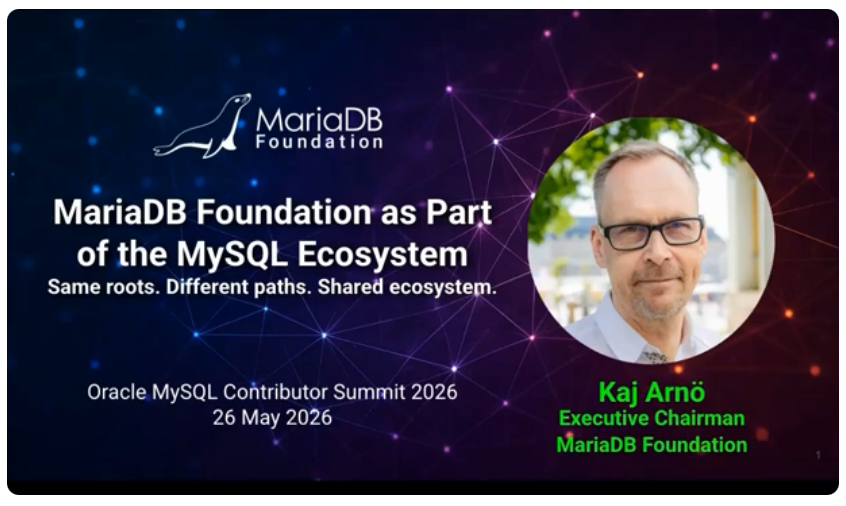
Last week, Oracle invited MariaDB Foundation to give a presentation at Oracle’s MySQL Contributor Summit 2026. I had the opportunity to participate remotely and speak about MariaDB’s role within the broader MySQL ecosystem.
First of all, I would like to thank Heather VanCura, VP Community Engagement at Oracle, and Jason Wilcox, SVP Data Services at Oracle, for the invitation and for creating a space where these discussions could happen openly and constructively.
The presentation itself is available here on YouTube. […]
-
The Rising Tide of Community Contributions to MariaDB Server
I wanted to share with you all some statistics on the incoming community contributions for the MariaDB server in the last year or so. And some of my thoughts looking at the data.
I’ve been quietly working on scripting some of my daily routines using the github CLI and the Jira REST API. Thanks to a question by Anna, the visionary MariaDB Foundation CEO, I’ve also created some scripts to fetch and summarize statistics on the incoming community contributions pull […]
-
Is MariaDB part of the MySQL ecosystem?

Why MariaDB is both its own database — and the natural continuation of MySQL
Because MariaDB is at the same time a completely independent database and a fundamentally compatible extension of MySQL, the MySQL user base is not dependent upon Oracle nor upon new forks of MySQL for their future. For pragmatical reasons – and those have always carried weight in the MySQL universe – MariaDB is part of the MySQL ecosystem.
Applications, teams, skills, investments, and use cases — all […]