

Tag: SysBench
-
Simple tool to build MariaDB commits for performance-change analysis
Tracking down changes in database performance is one of the hardest parts of engineering, especially when the change is buried somewhere in a long commit history.
To make this work easier and more repeatable, I put together a small but important tool:
MariaDBCommitBuilder.sh
This script does one thing well:
Given a commit hash, it checks out that commit, builds it cleanly, and packages it in a deterministic way so the Test Automation Framework (TAF) can run consistent performance tests.
Why […]
-
How MariaDB and MySQL performance changed over releases
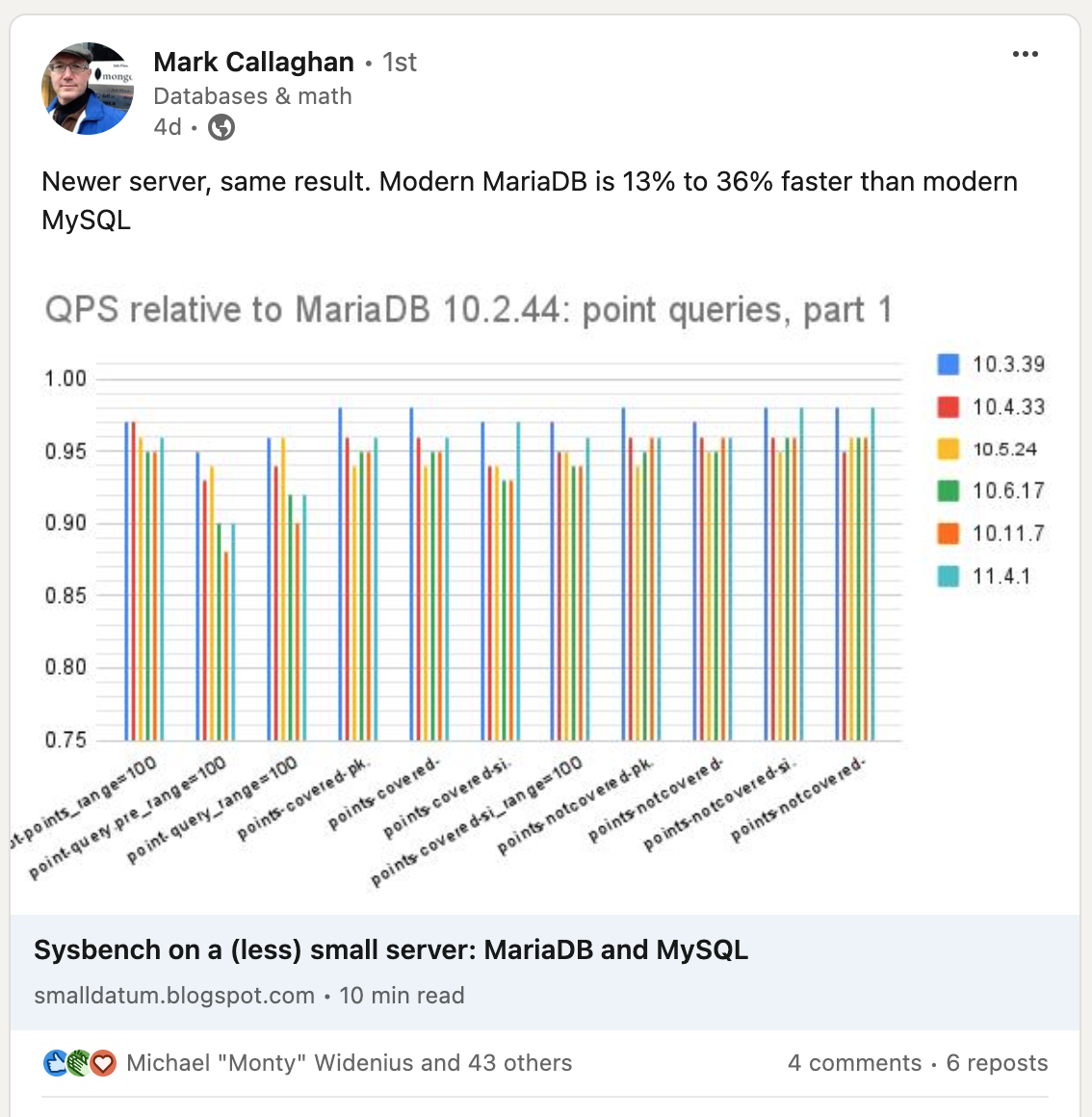
Is performance important for you, along with the latest features and long-term support? Go with MariaDB 11.4. But don’t take our word for it. We asked well known benchmarking expert Mark Callaghan to check out a number of MariaDB and MySQL releases, hit them hard with a tool of his choice, and share his findings.
MariaDB’s performance is stable over the years
The outcome: On the low concurrency load (high concurrency results are being prepared), MariaDB maintained stable performance over […]
-
Lua sysbench – crash course
This is a follow-up on my previous blog post about using Lua enabled sysbench. Today I will dive into how to write Lua scripts for sysbench. Look at this simple example:
There are 3 functions prepare(), cleanup() and help(). Those are executed when sysbench is asked to perform the respective action (i.e. sysbench … help).
If you do sysbench … run then things are different. First sysbench starts the requested number of threads and executes the thread_init() function for each. […]
-
Using Lua-enabled sysbench
A quite common benchmark for MySQL is sysbench. It was written nearly 10 years ago by Alexey Kopytov.
Sysbench has modes to benchmark raw CPU performance, mutex speed, scheduler overhead and file IO performance. The probably most often used sysbench mode is OLTP. This benchmark mimics a OLTP scenario with small transactions hitting an optimized database. There are many variables to play with, most important is the number of simulated application threads (option –num-threads). The OLTP benchmark can be run […]
-
MariaDB Introduces Atomic Writes
When dealing with high performance, low latency storage devices, such as SSD cards, one finds bottlenecks in new places. This is a story about such a bottle neck and how to work around it.
One unique feature of InnoDB is the double write buffer. This buffer was implemented to recover from half-written pages. This can happen in case of a power failure while InnoDB is writing a page (16KB = 32 sectors) to disk. On reading that page, InnoDB would […]
-
Sysbench OLTP: MySQL-5.6 vs. MariaDB-10.0
Oracle has now launched MySQL-5.6.10-GA, so it is time to come up with some new benchmark results. The test candidates in this benchmark run are
- MySQL-5.5.29
- MySQL-5.6.10
- MariaDB-5.5.28a
- MariaDB-10.0.1
-
Segmented key cache performance results for MariaDB 5.2.2-gamma
Recently I tested our new segmented key cache feature for MyISAM in MariaDB 5.2.2-gamma for performance gains. You can check our new features in MariaDB 5.2 in our Ask Monty Knowledge Base