

Tag: mysql
-
Building a Public Performance Change Detection Library for MariaDB
Performance engineering inside a database project is usually private. Teams run internal workloads, investigate changes, fix issues, and move on. The knowledge stays inside the company, and the outside world only sees a benchmark graph or a release note.
I know this pattern well — I spent more than twenty‑six years doing this work for both PervasiveSQL and MySQL.
The investigations were deep, the lessons were real, but almost none of it was visible to the outside world.
The surprises, […]
-
MariaDB Foundation Adds PostgreSQL to Its Engine‑Agnostic Testing Framework (TAF).
The Test Automation Framework (TAF) was designed so that database makers themselves could create a plugin and integrate their database engine directly into the framework.
TAF provides the structure — lifecycle management, workload execution, profiling, reporting, and reproducible properties files — and each database plugin supplies the engine‑specific logic.
The first two plugins added to TAF were MariaDB and MySQL, proving the model: database vendors can plug their engine into TAF and immediately gain automated installs, structured workloads, concurrency sweeps, […]
-
MariaDB Foundation: TAF Now Supports Embedded Database Configuration in User Properties
TAF: One File to Rule Them All
In a one‑on‑one review of TAF with Monty Widenius, the creator of MySQL and MariaDB, he looked at me and said: “I want everything in one user file.”
It was simple, direct, and completely right direction.
TAF’s configuration model had inherited its design from older frameworks — a user properties file and a separate database configuration file.
Monty’s comment cut straight through it. He wanted simplicity — one file that defines everything.
So […]
-
MariaDB Foundation Advances TAF with HammerDB 6.0 and xt_reservoir Integration
Overview
While validating MariaDB RSS stability under stored procedure workloads, I ran into unexpected memory growth. The goal was straightforward: confirm that MariaDB was not leaking memory when running TPROC-C stored procedure workloads. To do this, I used HammerDB TPROC-C SP and added improved RSS monitoring so I could watch memory usage over long-duration runs.
The results were clear. MariaDB RSS stayed stable. HammerDB 5.0 kept growing, and growing.
This led to a deeper investigation into HammerDB itself, and ultimately […]
-
Say the Name: MariaDB, MySQL, and the Ecosystem We Share

MariaDB and MySQL share history, tools, protocols and a large technical community. But compatibility does not mean identity—especially when reporting bugs. A MariaDB Connector/C issue submitted to the MySQL bug tracker offers a funny reminder to say the product’s actual name.
-
Simple tool to build MariaDB commits for performance-change analysis
Tracking down changes in database performance is one of the hardest parts of engineering, especially when the change is buried somewhere in a long commit history.
To make this work easier and more repeatable, I put together a small but important tool:
MariaDBCommitBuilder.sh
This script does one thing well:
Given a commit hash, it checks out that commit, builds it cleanly, and packages it in a deterministic way so the Test Automation Framework (TAF) can run consistent performance tests.
Why […]
-
The Power Of The Community!
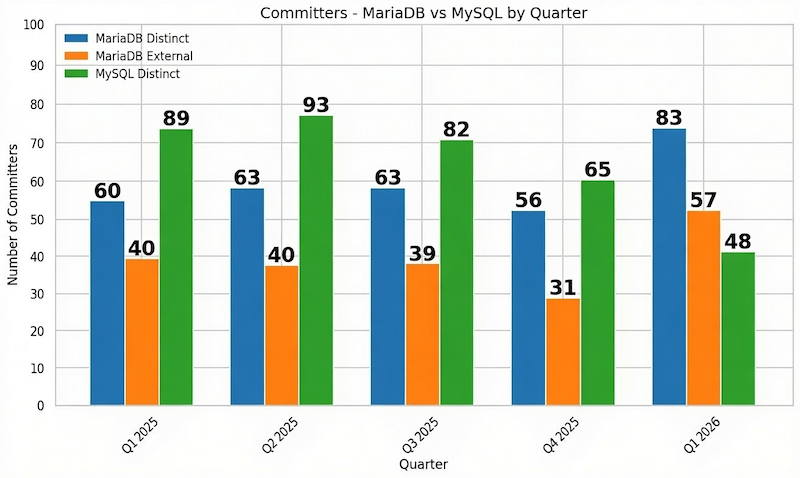
A proper comparison of the distinct committers to MariaDB and MySQL repositories since Q1 2025.
-
MariaDB Foundation at Oracle’s MySQL Contributor Summit: Ecosystems, Forks and Constructive Coexistence
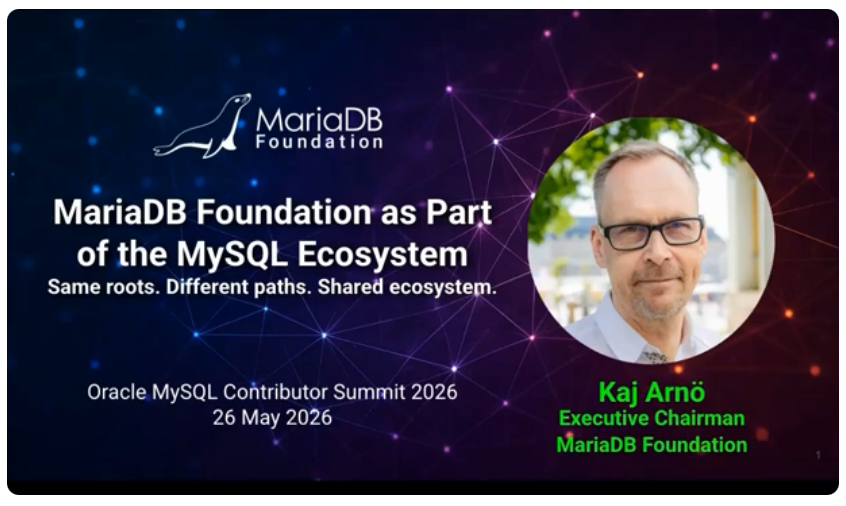
Last week, Oracle invited MariaDB Foundation to give a presentation at Oracle’s MySQL Contributor Summit 2026. I had the opportunity to participate remotely and speak about MariaDB’s role within the broader MySQL ecosystem.
First of all, I would like to thank Heather VanCura, VP Community Engagement at Oracle, and Jason Wilcox, SVP Data Services at Oracle, for the invitation and for creating a space where these discussions could happen openly and constructively.
The presentation itself is available here on YouTube. […]