

Tag: MariaDB
-
Hear Ye, Hear Ye: A Guide to MariaDB’s Governance Model
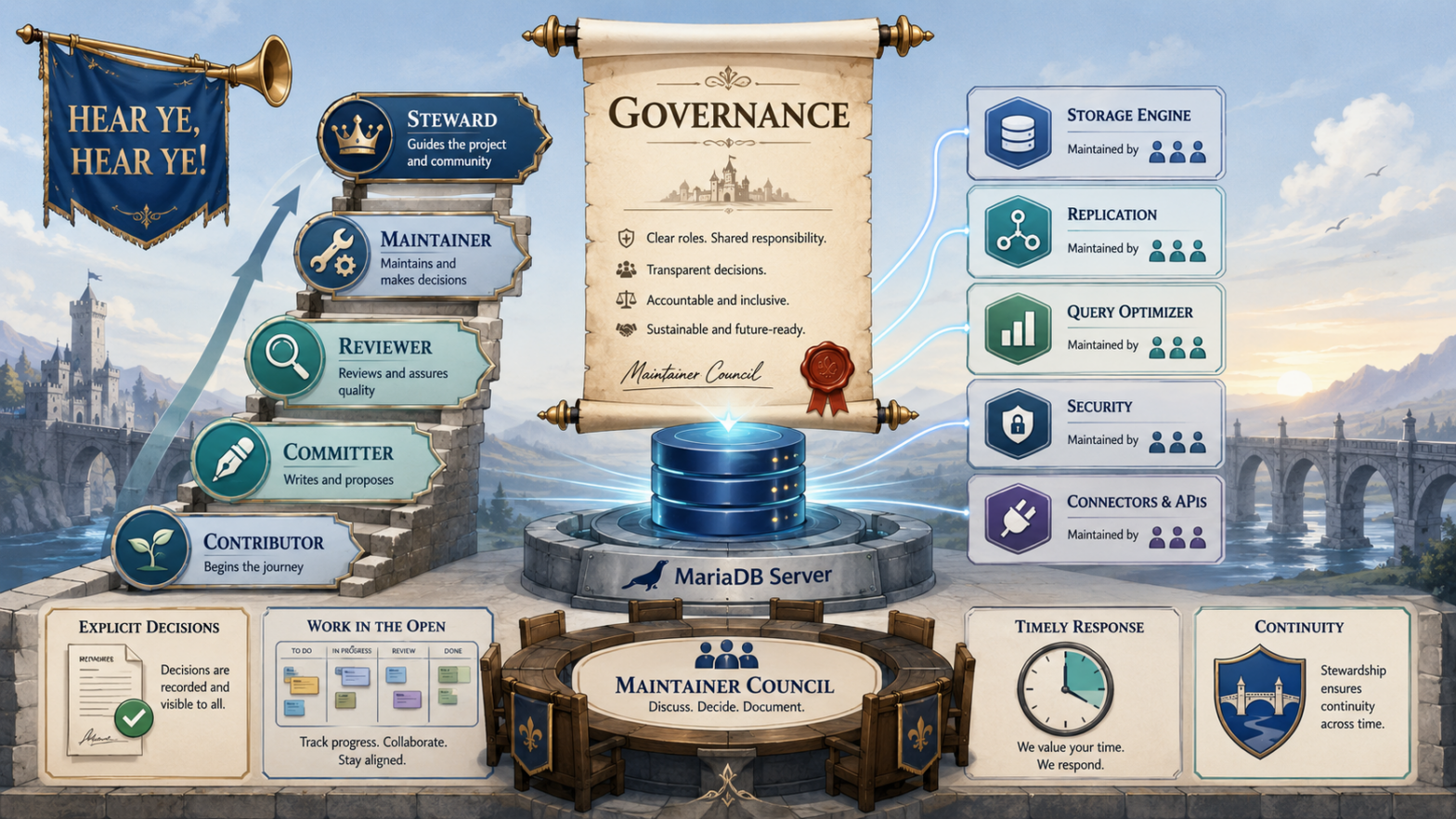
Be it known: MariaDB Server now has a clearer, publicly documented governance framework covering technical roles, subsystem ownership, decision-making, response expectations and continuity.
Open source begins with access to the code. Yet for infrastructure expected to remain dependable for many years, openness must also extend to how responsibility is assigned, how decisions are made, and what happens when people disagree or move on.
The framework formalises much of how the project has long worked, while making its responsibilities, decision paths […]
-
Say the Name: MariaDB, MySQL, and the Ecosystem We Share

MariaDB and MySQL share history, tools, protocols and a large technical community. But compatibility does not mean identity—especially when reporting bugs. A MariaDB Connector/C issue submitted to the MySQL bug tracker offers a funny reminder to say the product’s actual name.
-
Continuent joins MariaDB Foundation as a Silver Sponsor

MariaDB Foundation is pleased to welcome Continuent as a new Silver Sponsor.
Continuent develops solutions for organizations running business-critical applications on MariaDB and other MySQL-compatible databases. Its flagship product, Tungsten Cluster, helps organizations manage database availability, disaster recovery and distributed deployments across on-premises, cloud and hybrid environments.
The company has worked with open-source database technologies for more than two decades and brings extensive experience from demanding production environments across SaaS, financial services, telecommunications, e-commerce and other industries.
“Continuent has a […]
-
Nextcloud renews its Silver sponsorship of MariaDB Foundation
MariaDB Foundation is pleased to announce that Nextcloud has renewed its Silver sponsorship for another year.
Nextcloud and MariaDB are widely used together by organisations that want greater control over their data and infrastructure. Both projects form part of a broader open-source ecosystem that enables businesses, public-sector organisations and individuals to build digital services without unnecessary dependence on proprietary platforms.
Over the past year, our collaboration has also developed through the Privacy-First Solution Stack, which brings together Nextcloud, Passbolt and […]
-
Passbolt renews its support for MariaDB Foundation
MariaDB Foundation is pleased to announce that Passbolt has renewed its Silver sponsorship for another year, continuing its long-term support for the MariaDB open-source ecosystem.
Passbolt is an open-source password manager designed for teams, with a strong focus on security, privacy, and user control. Its continued support reflects a shared commitment to building practical, trustworthy open-source infrastructure that organizations can deploy and operate with confidence.
Building on the Privacy-First Stack
During the first year of collaboration, Passbolt became part of […]
-
Simple tool to build MariaDB commits for performance-change analysis
Tracking down changes in database performance is one of the hardest parts of engineering, especially when the change is buried somewhere in a long commit history.
To make this work easier and more repeatable, I put together a small but important tool:
MariaDBCommitBuilder.sh
This script does one thing well:
Given a commit hash, it checks out that commit, builds it cleanly, and packages it in a deterministic way so the Test Automation Framework (TAF) can run consistent performance tests.
Why […]
-
DuckDB Storage Engine for MariaDB. When the Sea Lion Learns to Quack.
An early look at the DuckDB storage engine for MariaDB — columnar, vectorized analytics that live right next to your transactional tables.
The problem
MariaDB’s InnoDB is excellent at what it was built for: transactions. Row-by-row inserts, updates, point lookups, strong consistency. But the moment you ask it to scan tens of millions of rows for a multi-way join with a few aggregations, a row store has to work hard.
The usual answer is to stand up a separate analytical […]
-
The Power Of The Community!
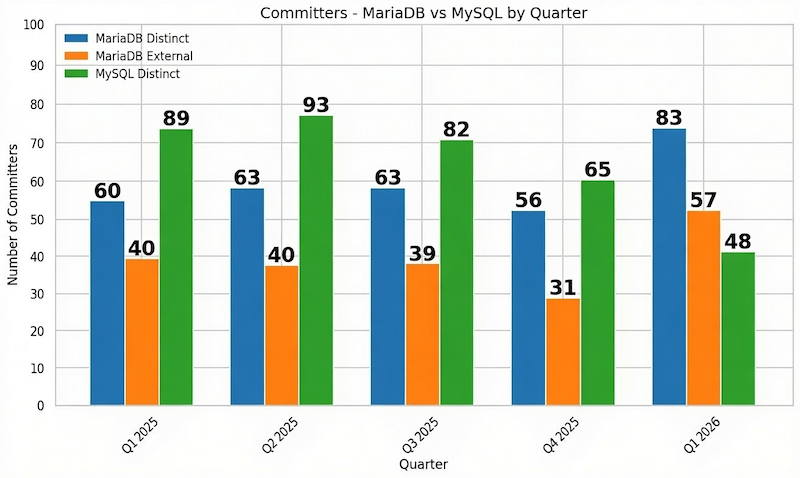
A proper comparison of the distinct committers to MariaDB and MySQL repositories since Q1 2025.