

Category: Contributions
-
MariaDB Server 12.3, 11.8, 11.4, 10.11, 10.6 – May 2026’s releases: thank you for your contributions

On May… we have released an update of our 5 current LTS releases:
These new releases contain a large amount of external contributions. The number of contributors is constantly growing, which is great!
On behalf of the MariaDB Foundation and the entire MariaDB Team, let me thank you all!
If we refer to MariaDB Server 11.8, we have about 62 contributions from 35 external contributors.
And with the latest 12.3.2, we increase that number to 57 external contributors!!! See Joro’s […]
-
DuckDB Storage Engine for MariaDB. When the Sea Lion Learns to Quack.
An early look at the DuckDB storage engine for MariaDB — columnar, vectorized analytics that live right next to your transactional tables.
The problem
MariaDB’s InnoDB is excellent at what it was built for: transactions. Row-by-row inserts, updates, point lookups, strong consistency. But the moment you ask it to scan tens of millions of rows for a multi-way join with a few aggregations, a row store has to work hard.
The usual answer is to stand up a separate analytical […]
-
The Power Of The Community!
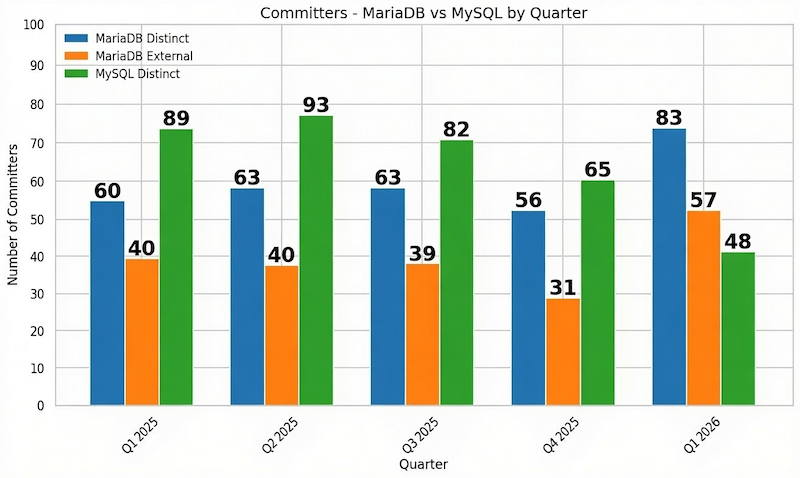
A proper comparison of the distinct committers to MariaDB and MySQL repositories since Q1 2025.
-
A New Pull Request Processing Time Record
We have a new record average time to process a pull request: 21 days!
Part of my job is following (and trying to improve of course) some key metrics about MariaDB Server pull request processing. As a part of that I compile a nice pull request metric and a graph of it. This is what it looked like for the last month:
There’s a single number that caught my attention: 21.05 ! This is a new record low! That’s how […]
-
Documented: The MariaDB Server (Community) Contribution Process
If you ever considered contributing code to the MariaDB server, you should know that this is an intricate process involving multiple steps and multiple actors. To help you see your contributions successfully merged into the MariaDB Server codebase I’ve compiled a comprehensive description of the contribution process itself, the roles involved into it, the sequence of actions and conditions for transition from one to another. There’s even a diagram!
Please go to COMMUNITY_CONTRIBUTIONS.md.
This of course is going to be […]
-
Adding a New Data Type to MariaDB with Type_handler – Part 5

We are concluding our series related to new data types using the Type_handler framework, with some limitations that are not yet covered by the framework:
It would have been handy for our MONEY datatype to have the possibility to define, for example, the currency to show. Or the format to have something like this:
Unfortunately, we can’t create new field attributes for our data type. As you probably already know, a column has an extra attribute called COMMENT. We can […]
-
Adding a New Data Type to MariaDB with Type_handler – Part 4

This is part 4 of a series related to extending MariaDB with a custom data type using the Type_handler framework.
You can find the previous articles below:
Overriding Existing Types
In the previous examples, our MONEY data type inherits from DOUBLE and then we override some methods.
But all the methods of every type cannot be overridden. For example, if we would like to change how the money column is sorted, we would have to override the Field_double::sort_string() method. But […]
-
Adding a New Data Type to MariaDB with Type_handler – Part 3

In the previous article, we wrote, compiled, and tested our first custom data type for MariaDB using the Type_handler framework.
But currently, aside from allowing the use of its new name (MONEY) and listing it in the metadata, our new data type behaves exactly like a DOUBLE, the class it inherits from.
In this article, we will extend our data type just a bit by transforming the result into a VARCHAR and adding a currency sign to it: the dollar […]