

Category: Foundation
-
We’re hiring: Senior MariaDB Developer / Code Reviewers
Yes, we are hiring!
And we are hiring for quite an interesting position: As a senior developer of MariaDB Server, with merging community code contributions as a main task.
A demanding job
This is a very demanding job. The MariaDB Server code base is large and complex, and being a good C / C++ developer is only the starting point for being able to contribute to it. You also need to understand databases, and the existing codebase architecture.
A demanding […]
-
MariaDB replication using containers
In this blog we are going to demonstrate how to replicate a MariaDB database that runs in a Docker container (let’s call it primary) to one or more MariaDB servers that run in a Docker container (let’s call them replicas) using binary logging, a method that creates binary log files and an index that contains the record of all changes to the database (both data and structure). You can find an overview of how replication works here and you can […]
-
Contributions, our lifeblood
The lifeblood of MariaDB Foundation is contributions. Our trinity consists of the fundamental values of Adoption (of MariaDB Server), Openness (of the MariaDB Server codebase), and Continuity (of our operations and activities), all of which are centered around MariaDB Server. We rely on our financial sponsors to finance our activities, but the financial value of the code contributions we receive outshines the total sponsorship payments. That has been the case every year since MariaDB Server was launched.
Giving recognition to […]
-
China Has Great Potential for MariaDB Server
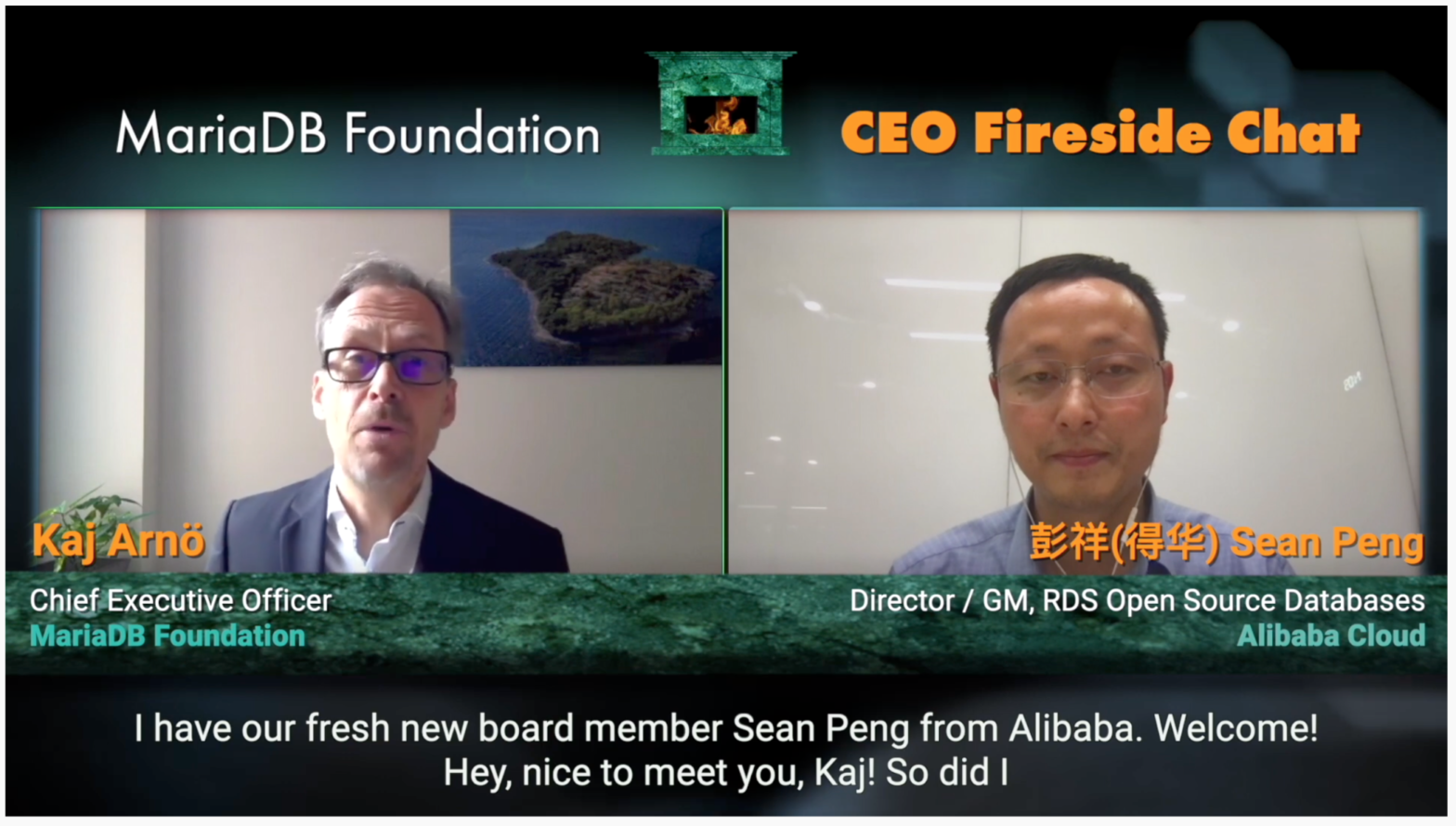
Our Board Meeting in April 2022 elected two seasoned new voting board members. One of them is Xiang Peng (Sean), Director, RDS Open Source Databases at Alibaba Cloud. I had the pleasure of having a Fireside Chat with him, which we recorded and put up on YouTube. Read on for his recommendations for MariaDB Foundation in China.
A Man With the Right CV for MariaDB Foundation
Sean, as he calls himself for those of us who have problems remembering, reading […]
-
Create statefulset MariaDB application in K8s
In the previous blog we created a stateless application, deployed with K8s resource Deployment, which allows one to replicate the application, but where data is lost when Pods are restarted, meaning there were no data consistency. In the same blog we used PersistentVolumeClaim for dynamic provisioning of PersistentVolume, but we used Deployment, meant for stateless application, and this way is *not recommended* for statefulset application where each replica should have its own persistent volume. The proper way to achieve that […]
-
MariaDB & K8s: Deploy MariaDB and WordPress using Persistent Volumes
In the previous blog, MariaDB & K8s: Create a Secret and use it in MariaDB deployment, we used the Secrets resource to hide confidential root user data, and in the blog before that in the series, MariaDB & K8s: Communication between containers/Deployments, we created 2 containers (namely MariaDB and phpmyadmin) in a Pod. That kind of deployment didn’t have any persistent volumes.
In this blog we are going to create separate Deployments for MariaDB and WordPress applications as well as […]
-
MariaDB & K8s: Create a Secret and use it in MariaDB deployment
In the previous blog we created a stateless application, deployed it with K8s resource Deployment, and exposed the root password, which, regarding security, is of course not recommended. K8s allows one to hide confidential data using specific K8s resources.
Let’s see how to use Secrets in K8s.
Secrets in K8s
In order to save confidential data one can use a K8s resource called Secret.
One can create Secret from the CLI by running kubectl create secret.
Here we will use […]
-
MariaDB & K8s: Communication between containers/Deployments
In the previous blog, a background Deployment resource was created from a YAML file, consisting of a single container (MariaDB) that acts as a background container.
In this blog we are going to proceed to create the frontend container to communicate with the backend through a Service and other resources.
About Services
When an application is run through the Deployment Pods are created and destroyed dynamically. When created, they get the internal IP address in a cluster, and since they […]