
Tag: PostgreSQL
-
Building a Public Performance Change Detection Library for MariaDB
Performance engineering inside a database project is usually private. Teams run internal workloads, investigate changes, fix issues, and move on. The knowledge stays inside the company, and the outside world only sees a benchmark graph or a release note.
I know this pattern well — I spent more than twenty‑six years doing this work for both PervasiveSQL and MySQL.
The investigations were deep, the lessons were real, but almost none of it was visible to the outside world.
The surprises, […]
-
MariaDB Foundation Adds PostgreSQL to Its Engine‑Agnostic Testing Framework (TAF).
The Test Automation Framework (TAF) was designed so that database makers themselves could create a plugin and integrate their database engine directly into the framework.
TAF provides the structure — lifecycle management, workload execution, profiling, reporting, and reproducible properties files — and each database plugin supplies the engine‑specific logic.
The first two plugins added to TAF were MariaDB and MySQL, proving the model: database vendors can plug their engine into TAF and immediately gain automated installs, structured workloads, concurrency sweeps, […]
-
Simple tool to build MariaDB commits for performance-change analysis
Tracking down changes in database performance is one of the hardest parts of engineering, especially when the change is buried somewhere in a long commit history.
To make this work easier and more repeatable, I put together a small but important tool:
MariaDBCommitBuilder.sh
This script does one thing well:
Given a commit hash, it checks out that commit, builds it cleanly, and packages it in a deterministic way so the Test Automation Framework (TAF) can run consistent performance tests.
Why […]
-
Database Trends: What is changing in the database world (besides AI)

Earlier this month, I had a half-hour chat with Kellyn Gorman, a Database and AI Advocate and Engineer at Redgate. The UK software company is known for database DevOps and database management tools most databases – and since 2024 as the owner of DB-Engines popularity Ranking of database management systems.
The chat was an intellectual pleasure, to say the least. Kellyn is outstandingly well informed on databases, with a background starting in Oracle, spanning most databases as a DBA and […]
-
The Real Operational Cost of Vacuuming in PostgreSQL
There was a time when PostgreSQL’s own developers were far more open about the real cost of their MVCC design. Back in the 8.1 era, the documentation spelled out the resource drain, the vacuum overhead, and the “cold comfort” of wraparound risk in plain language. I first read that line in 2003, and it stuck with me for more than twenty years. I could not imagine any serious operations team wanting a database that required a separate background process to […]
-
Making MariaDB the Natural Successor to MySQL

At the MariaDB Foundation, clarity of purpose matters. In an ecosystem as foundational as open-source databases, confidence is built not through slogans, but through predictability, restraint, and long-term commitment.
As I reflect upon what we learned in 2025 and how we can serve the database community in 2026, one thought stands out: MariaDB is the natural successor to MySQL, as Oracle loses its interest in the development of what has been the default Open Source Relational DBMS.
The MariaDB Foundation […]
-
MariaDB vs PostgreSQL: Understanding the Architectural Differences That Matter

This blog post is based on the YouTube presentation “MariaDB vs PostgreSQL: Technical Deep Dive | Architecture, Performance & Design Trade-offs” by Manoj Vakeel, part of MariaDB Foundation’s ongoing series exploring core database design choices and how they impact modern workloads.
The goal here is not to pick a “winner,” but to provide clear architectural insight for CTOs, database engineers, and system architects making decisions in 2025 and beyond.
“Both are powerful engines — both are proven in production — […]
-
Selecting the right database
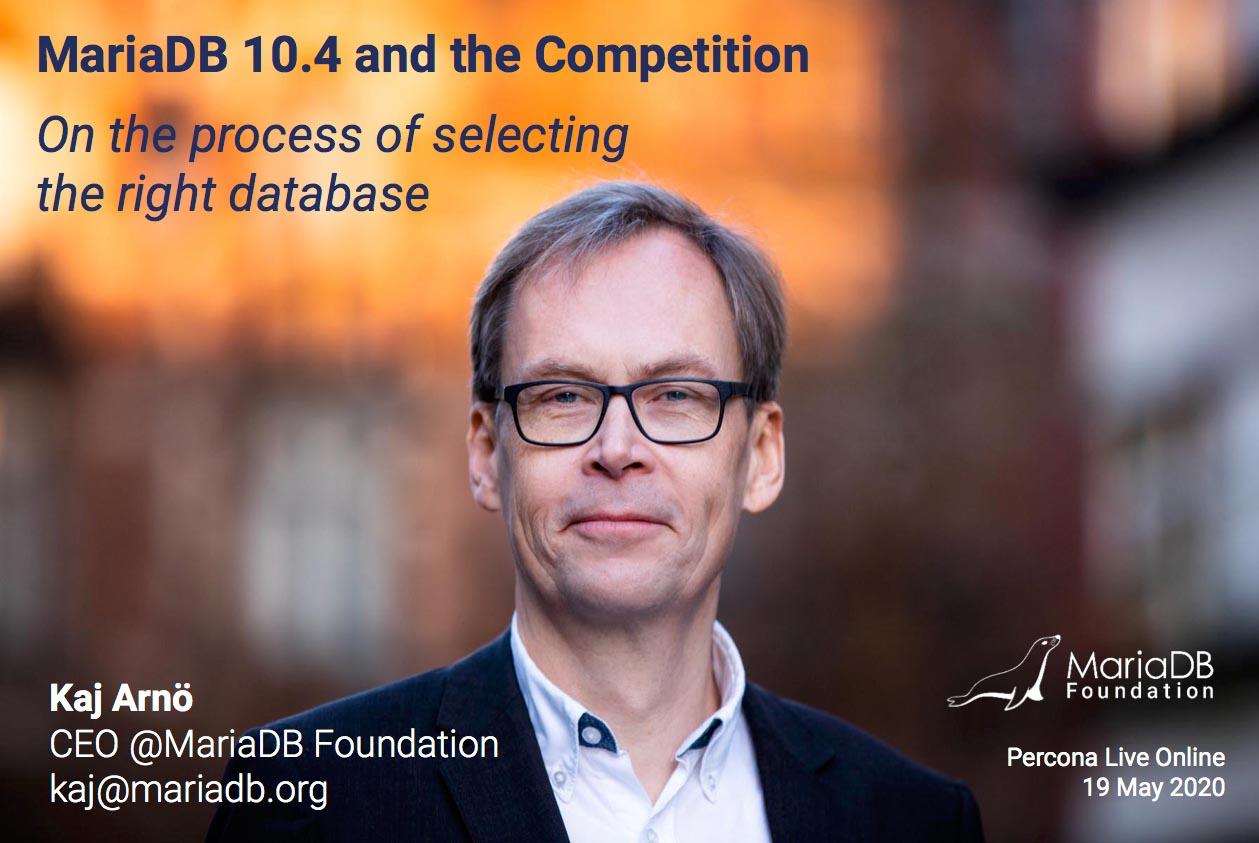
How do you select a database in practice? How do you pretend to select it? And, if you want to be serious, how do you select it logically?
Those are the key questions I dug into, during my keynote last week at Percona Live Online.
For those who feel they don’t want to listen to the entire 30 minute video of the presentation, I have compiled a number of entry points for you below:
- 0:23 Silly hat meme, “Teknologmössa”
- 2:19 Agenda
- 2:43 Choosing a database in practice
- 3:59 Pretending to choose a database
- 5:00 Triggers for making a fresh choice
- 5:51 Monetary impulses
- 7:53 Database lifecycle impulses
- 10:07 MariaDB 5.5 on Github
- 11:24 Framework for database choice: 1. Technology 2. Business 3. Ethics
- 13:49 Technology questions within framework
- 15:21 NoSQL in MariaDB – native JSON support
- 15:41 “Non-relational persistent data considered evil”
- 18:30 “Closed source databases considered evil”
- 18:41 DBS Bank migrated off Oracle to MariaDB 10.3
- 19:47 Choosing a database logically
- 19:57 “This is a sensitive topic”
- 20:25 Picking Postgres vs picking MySQL/MariaDB
- 21:24 Picking MariaDB vs picking MySQL
- 21:54 Questions meant to help you make the right choice
- 22:32 The importance of presence in Linux distributions
- 22:50 The release model: the importance of separating feature releases from bug fix releases
- 23:28 Business questions within framework
- 23:54 Controlling the roadmap of the database
- 24:46 Ethical questions within framework
- 25:30 Comparing Planet MySQL and Planet MariaDB blacklisting and whitelisting
- 26:27 Hats off to Oracle for taking care of MySQL much better than I had thought
- 26:58 Hats off to Percona for helping to keep MySQL alive
- 27:13 Ethical questions: attitude to openness
- 27:59 Ethical questions: governance
- 28:01 MariaDB Corporation
- 28:18 MariaDB Foundation
- 28:43 Checks and balances in governance
- 29:02 Backwards Compatibility, data formats not changing
- 29:35 Promoting health: Solstice Run 20 June 2020 – let’s do some running!
- 30:29 Concluding words: We need your help to make your path of least resistance point towards MariaDB Server