
Blog
-
When AI Finds the Bugs We Missed: A Very Busy Year for MariaDB Security
You may have noticed that some recent MariaDB Server releases arrived a little later than expected. Sorry about that! But there is a good reason for it.
Over the last months, the MariaDB project has experienced something we had never seen before: a very large increase in security reports. And when I say large, look at this graph:
For years, we received a few security reports every quarter. Sometimes 3, sometimes 6, 11… the highest in the graph was 16.
-
MariaDB Foundation: TAF Now Supports Embedded Database Configuration in User Properties
TAF: One File to Rule Them All
In a one‑on‑one review of TAF with Monty Widenius, the creator of MySQL and MariaDB, he looked at me and said: “I want everything in one user file.”
It was simple, direct, and completely right direction.
TAF’s configuration model had inherited its design from older frameworks — a user properties file and a separate database configuration file.
Monty’s comment cut straight through it. He wanted simplicity — one file that defines everything.
So […]
-
MariaDB Foundation Newsletter – October 2026
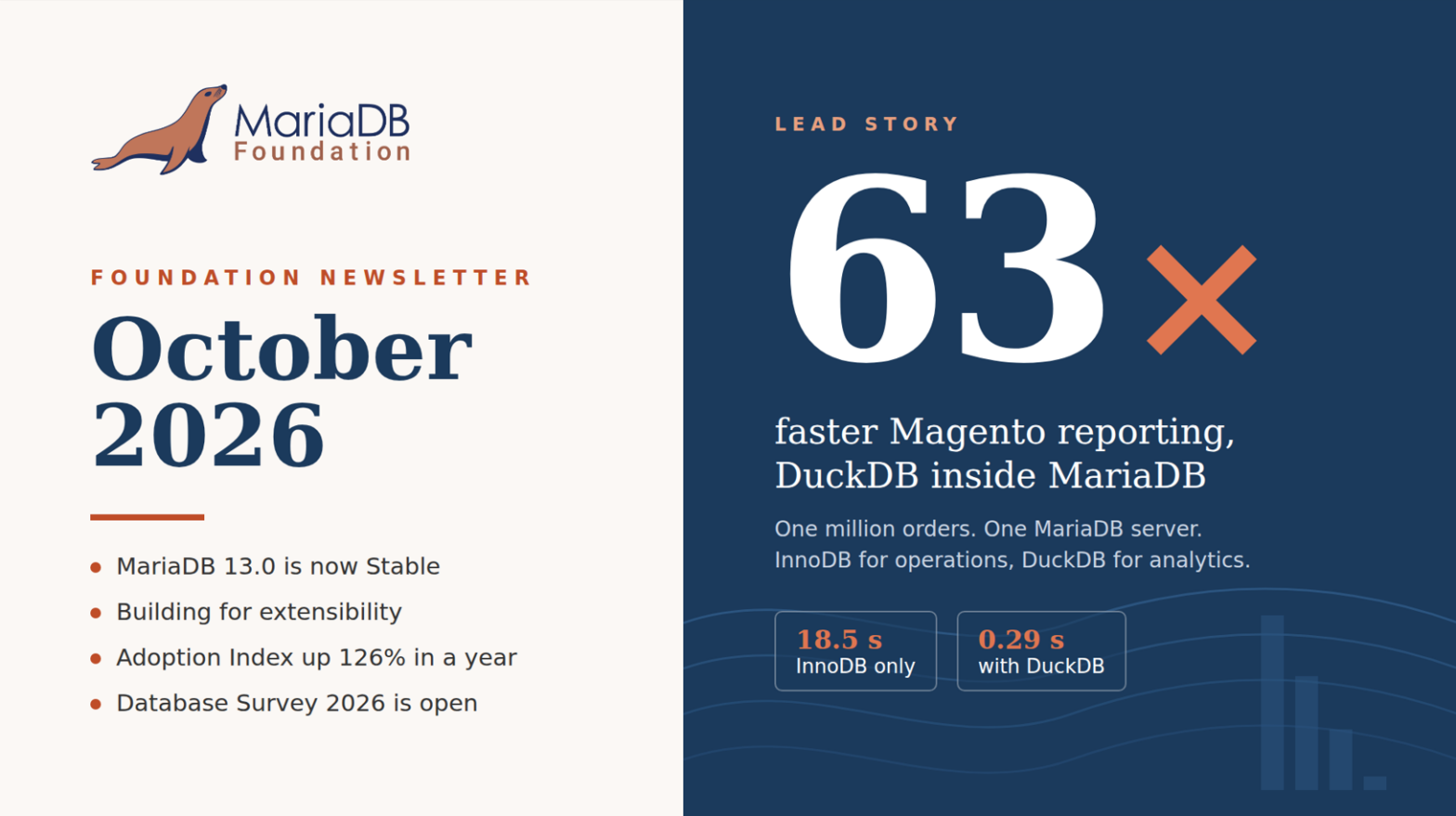
September showed what an extensible MariaDB looks like in practice. A Magento report ran 63 times faster once its tables moved to the DuckDB storage engine, which now ships with MariaDB 13.0, Stable since 17 September. TideSQL became far easier to install, the community voted on writing plugins beyond C++, and the Adoption Index is up 126% in a year. AWS renewed as Diamond sponsor for a fourth year, and Kamatera and Elestio joined as Silver Sponsors. Here’s what happened.
-
Elestio joins MariaDB Foundation as a Silver Sponsor
MariaDB Foundation welcomes Elestio as a Silver Sponsor, supporting the open-source project behind its managed MariaDB offering.
Elestio provides managed MariaDB with automated backups, monitoring and updates, allowing users to choose their cloud provider, region and resources. Its support for the Foundation helps sustain MariaDB’s development and grow the ecosystem around it.
Making MariaDB easier to choose and run
Choosing a database also means deciding how to deploy, maintain and operate it. Managed services give teams a practical path to […]
-
MariaDB Foundation: Why Test Case Tags Matter in TAF
In performance testing, numbers alone rarely tell the full story.
A benchmark result without context is just a result floating in space disconnected from the intent, and the conditions that produced it.
For the MariaDB Foundation, where transparency and reproducibility are core principles, this isn’t good enough.
Before diving into the details of the TAF 4.0 test-case-tag properties, the Foundation appreciates your input in the MariaDB Foundation Annual Survey
Back to test-case-tags, TAF treats the test case tag as a […]
-
MariaDB Foundation’s Test Automation Framework (TAF) 4.0 Release
MariaDB Foundation’s Performance Test Automation Framework (TAF) 4.0 Release represents the biggest changes to the framework since its creation.
This release reshapes how we organize, run, and report database workloads across MariaDB, MySQL, and now PostgreSQL.
The improvements are not just incremental — they fundamentally change how results are collected, tagged, and analyzed across the entire automation pipeline.
Several of the changes in TAF 4.0 were driven directly by requests from Monty, the creator of both MySQL and MariaDB.
Monty’s […]
-
Kamatera joins MariaDB Foundation as a Silver Sponsor
MariaDB Foundation welcomes Kamatera, a global cloud infrastructure provider, as its newest Silver Sponsor.
Kamatera provides scalable cloud servers and infrastructure across a worldwide network of data centres, giving developers and organisations control over where and how they run their applications. That flexibility makes it a natural environment for open-source technologies such as MariaDB, which users can deploy, configure and scale according to their own technical and geographic requirements.
“MariaDB belongs wherever developers choose to build and run their applications,” […]
-
TideSQL 5 and MariaDB: the Tides Are Moving Fast
A few months ago, I wrote about my first experiments with TideSQL, the MariaDB storage engine powered by TidesDB.
At that time, getting started meant building the TidesDB library, adding the TideSQL sources to the MariaDB source tree, compiling everything, installing the plugin and finally playing with:
It worked, and I liked what I saw.
But things are moving fast.
TideSQL 5.0.0 is now available, based on TidesDB 10, and I think it is time to have another look at […]