
Blog
-
MariaDB Foundation Advances TAF with HammerDB 6.0 and xt_reservoir Integration
Overview
While validating MariaDB RSS stability under stored procedure workloads, I ran into unexpected memory growth. The goal was straightforward: confirm that MariaDB was not leaking memory when running TPROC-C stored procedure workloads. To do this, I used HammerDB TPROC-C SP and added improved RSS monitoring so I could watch memory usage over long-duration runs.
The results were clear. MariaDB RSS stayed stable. HammerDB 5.0 kept growing, and growing.
This led to a deeper investigation into HammerDB itself, and ultimately […]
-
MariaDB 13.1 Feature in Focus: JSON Operators and JSON_TABLE Improvements
JSON support in MariaDB has improved significantly over the years.
We have functions to create JSON documents, extract values, modify objects, inspect arrays, compare documents, and even transform JSON into relational rows using JSON_TABLE().
But sometimes, a very small piece of syntax can make a surprisingly large difference.
With MariaDB 13.1, we can finally write:
and:
Yes, the JSON arrow operators have arrived in MariaDB!!
And MariaDB 13.1 also improves JSON_TABLE() with support for formatted JSON columns, allowing complete JSON […]
-
MariaDB Foundation is pleased to welcome Auree as a Silver Sponsor.
Auree is building a cloud-independent platform for deploying and operating highly available open source databases, including MariaDB, inside customers’ own cloud accounts. Its Bring Your Own Cloud model allows organisations to choose their cloud provider, region, infrastructure size, and security environment while Auree automates database provisioning, monitoring, backups, clustering, and failover.
This approach addresses a growing concern among organisations adopting managed database services: how to gain the operational benefits of the cloud without surrendering control of their data, infrastructure, or […]
-
Hear Ye, Hear Ye: A Guide to MariaDB’s Governance Model
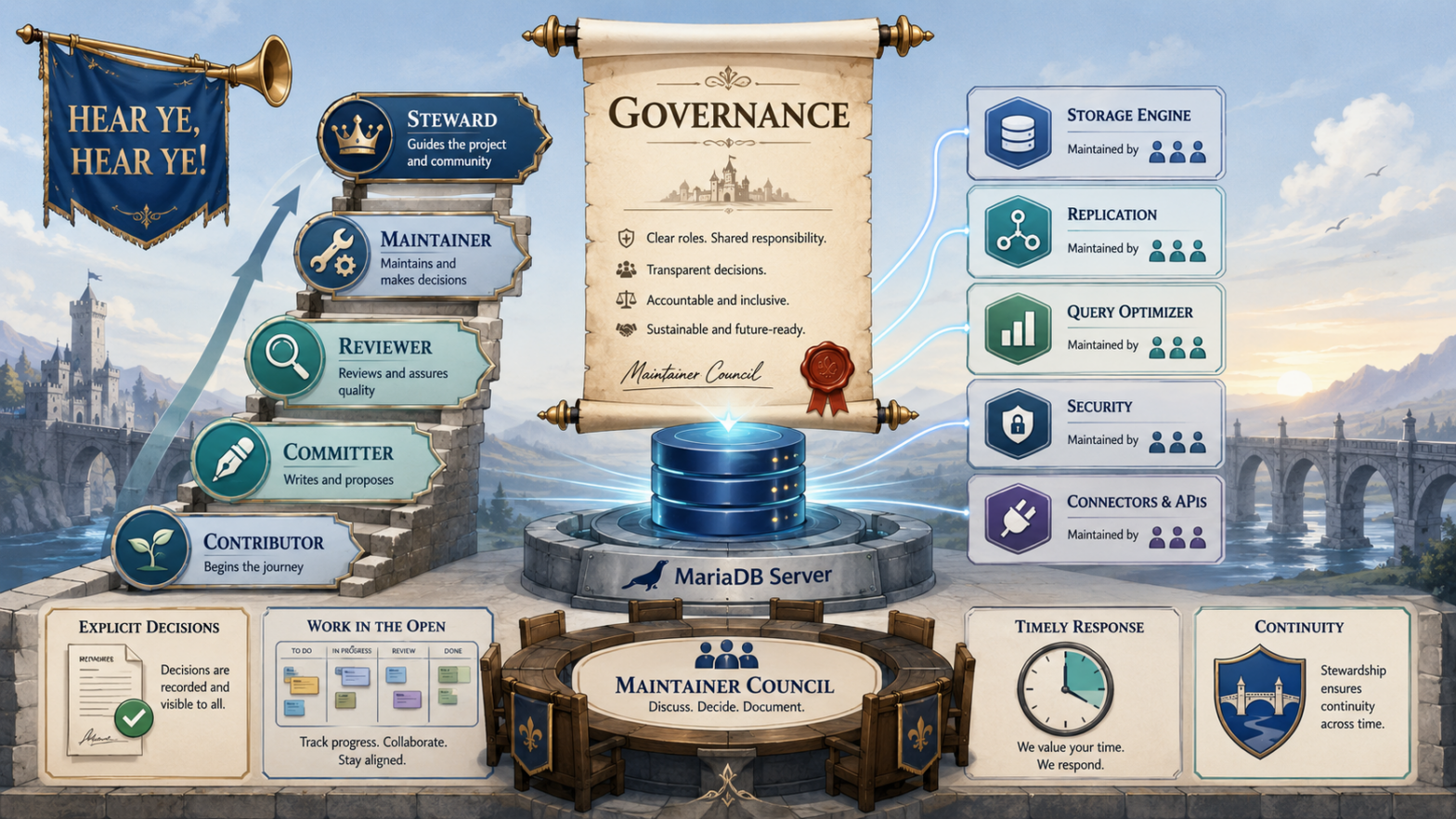
Be it known: MariaDB Server now has a clearer, publicly documented governance framework covering technical roles, subsystem ownership, decision-making, response expectations and continuity.
Open source begins with access to the code. Yet for infrastructure expected to remain dependable for many years, openness must also extend to how responsibility is assigned, how decisions are made, and what happens when people disagree or move on.
The framework formalises much of how the project has long worked, while making its responsibilities, decision paths […]
-
Wirekite becomes Silver Sponsor of MariaDB Foundation
We are pleased to welcome Wirekite as a new Silver Sponsor of MariaDB Foundation.
Wirekite is an enterprise data movement platform focused on high-performance extract, load, migration, and replication workflows. Its technology helps organisations move data across database systems and keep data fresh between operational systems, analytics platforms, and application environments.
For MariaDB users, this matters because data movement is often part of real-world database adoption. Organisations do not choose databases in isolation. They need practical ways to migrate, replicate, […]
-
From a Production Problem to MariaDB: Headout’s Open-Source Contribution Journey
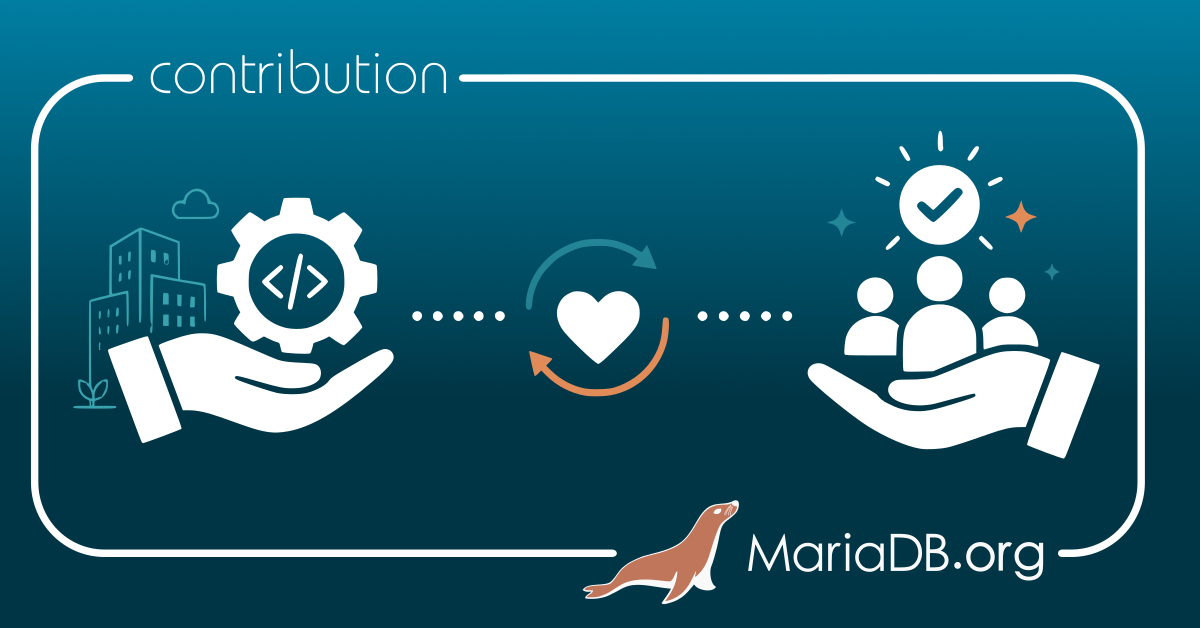
A production bottleneck at Headout led to a new MariaDB Server improvement. This is the story of how engineers, maintainers and AI-assisted development turned a real-world problem into an upstream open-source contribution.
-
Adobe Commerce Chooses MariaDB as Its Default Database Platform
Adobe Commerce is making MariaDB its default and recommended database platform.
-
ScalaHosting Becomes a Gold Sponsor of MariaDB Foundation
Global cloud hosting provider supports the continued development and adoption of open-source MariaDB
MariaDB Foundation is pleased to welcome ScalaHosting as a Gold Sponsor, strengthening the relationship between the MariaDB community and one of the hosting industry’s established cloud infrastructure providers.
ScalaHosting provides managed cloud VPS, web hosting and high-availability hosting services to customers around the world. Its platforms support MariaDB as a database option for websites, applications and online businesses, giving developers and organisations access to open-source database technology […]